
The Memo - 28/Jun/2026
Mid-year report, GPT-5.6 Sol, Midjourney Medical, and much more!

To:      US Govt, major govts, Microsoft, Apple, NVIDIA, Alphabet, Amazon, Meta, Tesla, Citi, Tencent, IBM, & 10,000+ more recipients…
From:    Dr Alan D. Thompson <LifeArchitect.ai>
Sent:    28/Jun/2026
Subject: The Memo - AI that matters, as it happens, in plain English
AGI:     97%
ASI:     2/50
Livestreams are back, the next one is in about 18 hours from this email, and will run weekly on Sunday evenings or Monday mornings, depending on where in the world you are.
The Memo features in recent AI papers by Microsoft and Apple, has been discussed on Joe Rogan’s podcast, and a trusted source says it is used by top brass at the White House. Across over 100 editions, The Memo continues to be the #1 AI advisory, informing 10,000+ full subscribers including RAND, Google, and Meta AI. Full subscribers have complete access to all 25+ AI analysis items in this edition!
Contents
The BIG Stuff (The sky is massive, GPT-5.6 Sol…)
The Interesting Stuff (Midjourney Medical, enterprise AI spending, Paradromics…)
Policy (EU watermarking text, China’s AI, xAI US$2.8B gas turbines approved…)
Toys to Play With (Claudecraft live, ghost names, AI world cup commentator…)
Things I’ve Been Thinking About (AI education in China, how AI will change us…)
Next (Roundtable…)
The BIG Stuff
Integrated AI: The sky is massive (mid-2026 AI retrospective) (Jun/2026)
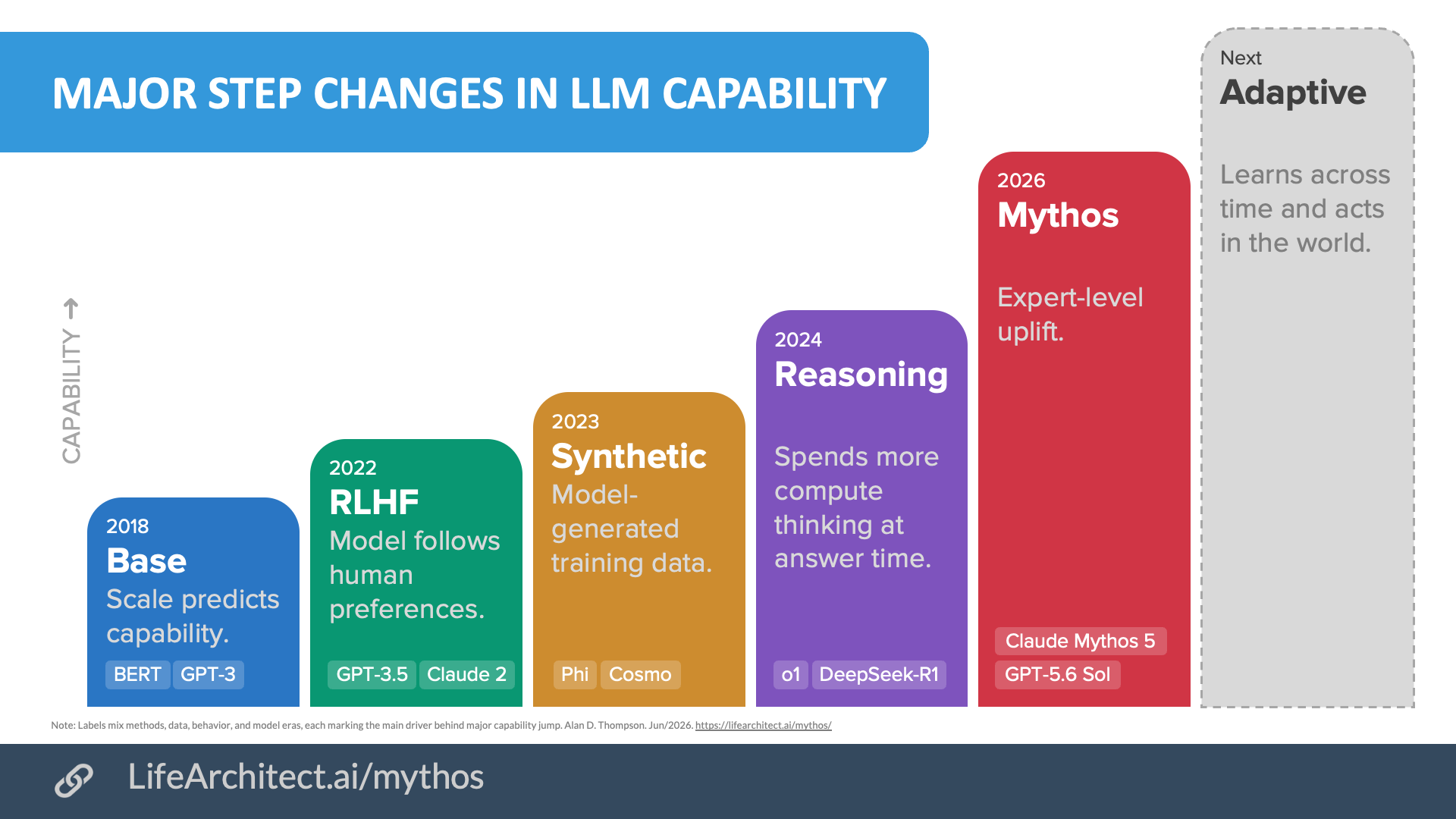
Full subscribers received my mid-2026 AI retrospective paper last week. It documents a period defined by massive scale: ChatGPT hit one billion monthly app users, Anthropic’s annualised revenue surged from US$9B to US$30B in four months, 17 new trillion-parameter models launched outside the big five labs, and total AI output surpassed total human language output for the first time.
Read more: https://lifearchitect.ai/the-sky-is-massive/
GPT-5.6 Sol: a next-generation model (26/Jun/2026)
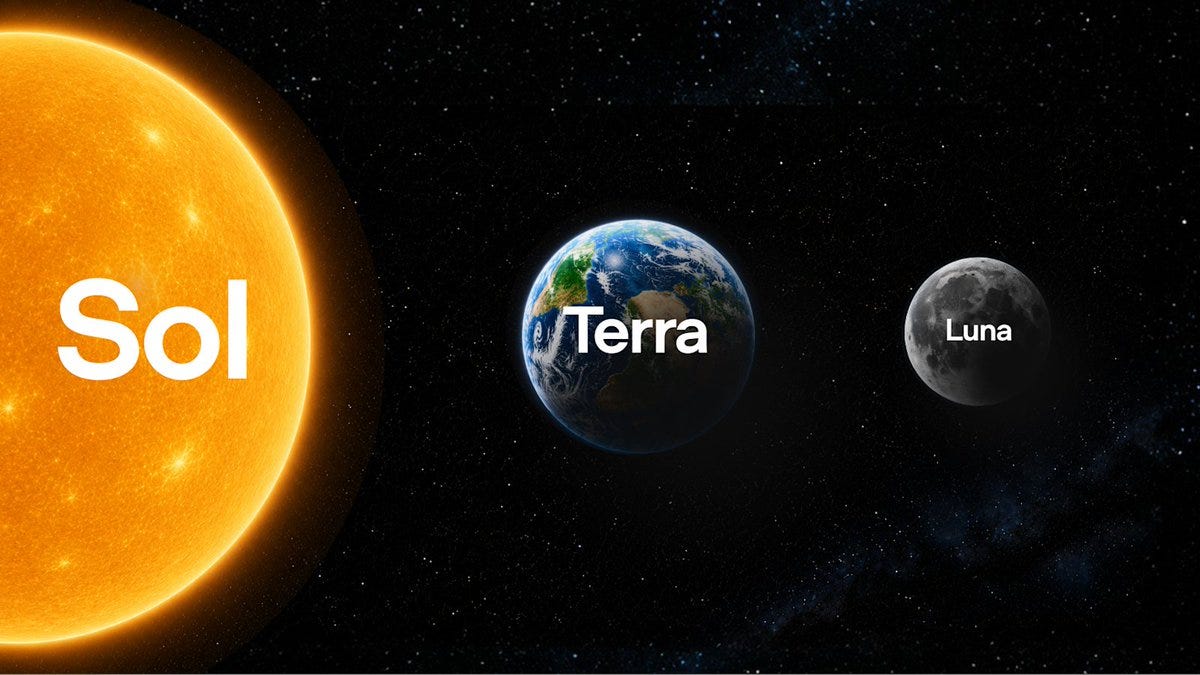
OpenAI announced the GPT-5.6 series in limited preview: Sol (flagship), Terra (balanced, competitive with GPT-5.5 at 2x cheaper), and Luna (lowest cost). Sol introduces an ‘ultra mode’ that deploys subagents to accelerate complex tasks, with pricing at US$5/$30 per MTok (compare to Claude Mythos/Fable at $10/$50 per MTok). The model also launches on Cerebras at up to 750 tok/s in Jul/2026, and OpenAI dedicated over 700,000 A100-equivalent GPU hours to automated red teaming focused on universal jailbreak discovery.
GPT-5.6 is not available to the public at launch.
Read more via OpenAI & see it on the Models Table: https://lifearchitect.ai/models-table/
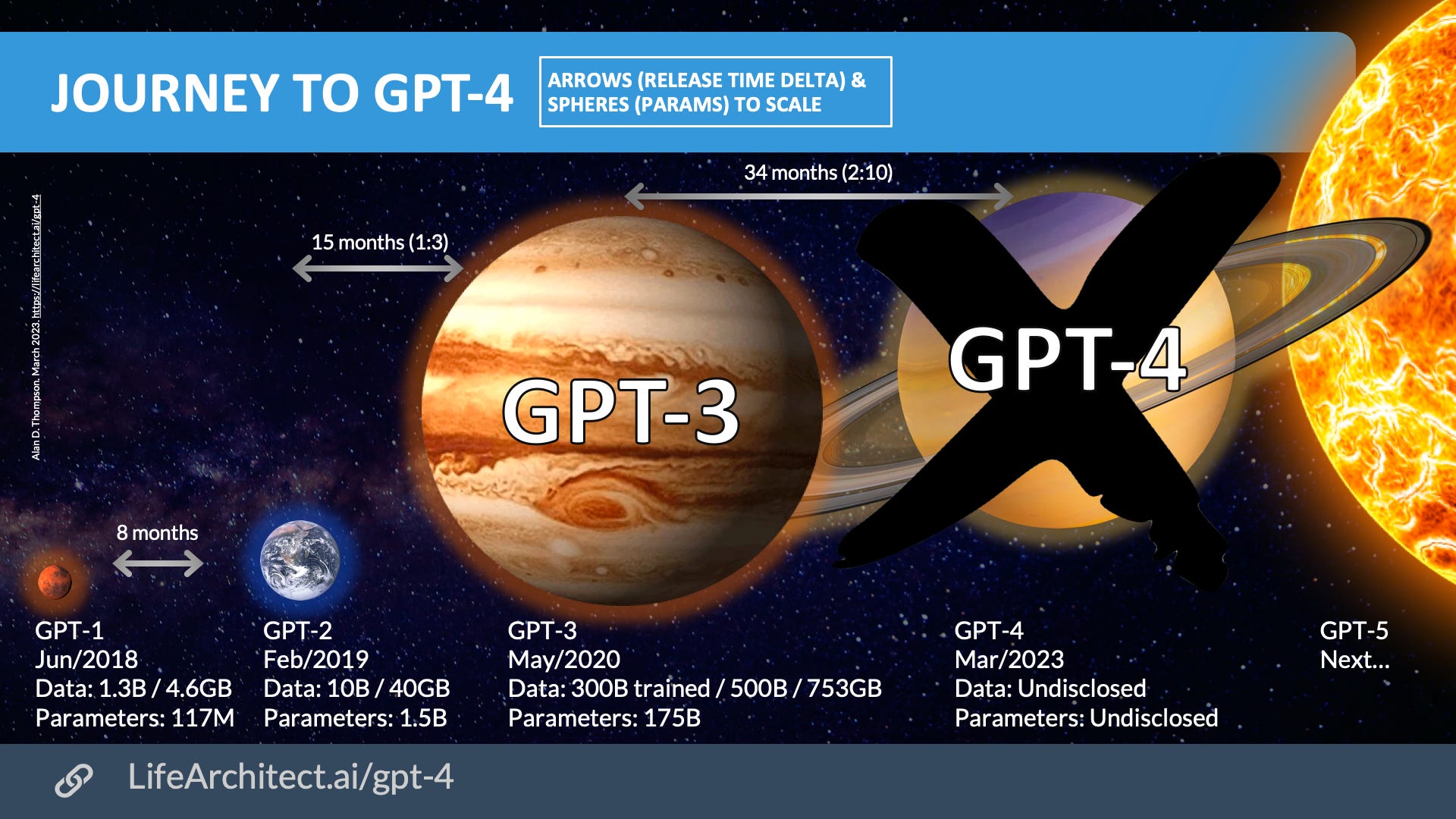
Sidenote: Great to see OpenAI again demonstrating morphic resonance (1981) or something similar in their graphics and visualizations. Compare one of my GPT-4 visualizations from 3¼ years ago:
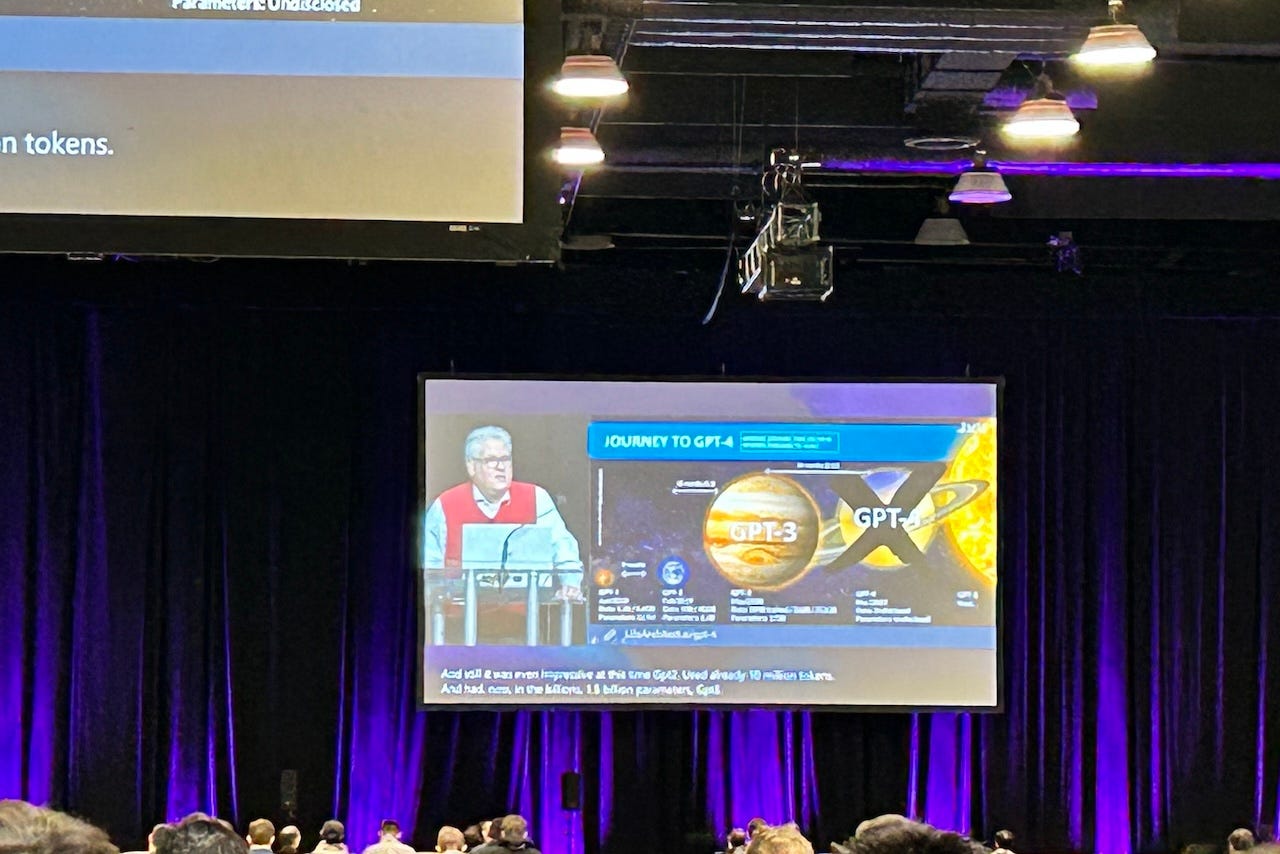
Of course, the real story here is the banning of frontier models (covered in The Memo Special Edition, 15/Jun/2026), and it began in anger this month, though the foundations were laid years ago.
Here is a quick timeline to how we got here, shaped by quotes from experts and me:
OpenAI, GPT-2 announcement, Feb/2019:
”Due to our concerns about malicious applications of the technology, we are not releasing the trained model.”
OpenAI, GPT-3 API announcement, Jun/2020:
“Since it is hard to predict the downstream use cases of our models, it feels inherently safer to release them via an API and broaden access over time, rather than release an open source model where access cannot be adjusted if it turns out to have harmful applications… We are launching today in a private beta rather than general availability.”
MIT Technology Review, Sep/2020:
”Microsoft announced it would begin exclusively licensing GPT-3… Only Microsoft, however, will have access to GPT-3's underlying code, allowing it to embed, repurpose, and modify the model as it pleases.”
OpenAI’s DALL-E 2 analysis, Apr/2022:
“…access to the model is currently given to a limited number of users, many of whom are selected from OpenAI employees’ networks… simply having access to an exclusive good can have indirect effects and real commercial value. For example, people may establish online followings based on their use of the technology, or develop and explore new ideas that have commercial value without using generations themselves. Moreover, if commercial access is eventually granted, those who have more experience using and building with the technology may have first mover advantage – for example, they may have more time to develop better prompt engineering techniques.”
Demis Hassabis, DeepMind CEO, TIME, Jan/2023:
”[Hassabis] admits that the company may soon need to change its calculus. ‘We’re getting into an era where we have to start thinking about the freeloaders, or people who are reading but not contributing to that information base,’ he says. ‘And that includes nation states as well.’ He declines to name which states he means—’it’s pretty obvious, who you might think’—but he suggests that the AI industry’s culture of publishing its findings openly may soon need to end.”
Ilya Sutskever, OpenAI’s chief scientist and co-founder, The Verge, Mar/2023:
“GPT-4 is not easy to develop. It took pretty much all of OpenAI working together for a very long time to produce this thing. And there are many many companies who want to do the same thing…“These models are very potent and they’re becoming more and more potent. At some point it will be quite easy, if one wanted, to cause a great deal of harm with those models. And as the capabilities get higher it makes sense that you don’t want want to disclose them.”
When asked why OpenAI changed its approach to sharing its research, Sutskever replied simply, ‘We were wrong. Flat out, we were wrong. If you believe, as we do, that at some point, AI — AGI — is going to be extremely, unbelievably potent, then it just does not make sense to open-source. It is a bad idea… I fully expect that in a few years it’s going to be completely obvious to everyone that open-sourcing AI is just not wise.”
Alan, GPT-4 analysis, Mar/2023:
“OpenAI cronyism and preferential treatment. Some ‘friends’ of OpenAI got access to the GPT-4 model eight months ago, in August 2022. This included OpenAI’s President giving his former company Stripe early access to the model. I find this to be especially egregious given that OpenAI planned on ‘delaying deployment of GPT-4 by a further six months [to Sep/2023]’ (paper) before making the model more generally available.”
Alan, quoted by The Brookings Institution, Sep/2023:
“…before OpenAI released GPT-4, it gave privileged access to a few select partners that could start building on its foundation before any competitors, giving rise to accusations of cronyism (Thompson 2023). At least one of these partners – Stripe – has also received early stage investments from OpenAI CEO Sam Altman. Preferential access has the potential to allow the producers of foundation models or their affiliates to vertically expand their market power without market competition, with all the associated antitrust implications.”