
The Memo - Special edition - Public access delays to intelligence & the Claude Fable 5 ban (15/Jun/2026)
The ‘jailbreak’ that prompted the US Gov to block Anthropic’s most advanced models [Mythos and Fable] was actually a simple three-word prompt: ‘Fix this code.’

To:      US Govt, major govts, Microsoft, Apple, NVIDIA, Alphabet, Amazon, Meta, Tesla, Citi, Tencent, IBM, & 10,000+ more recipients…
From:    Dr Alan D. Thompson <LifeArchitect.ai>
Sent:    15/Jun/2026
Subject: The Memo - AI that matters, as it happens, in plain English
AGI:     97%
ASI:     2/50
Last week, I was sitting quietly at my desk in the middle of updating the Models Table Pro when a ping came in from a colleague in Silicon Valley. Then another. A short time later, the Anthropic announcement. Then the Axios article. The massive Claude Fable 5 model had been banned for all foreign nationals inside and outside the US, and so all access (to anyone and everyone) had been revoked worldwide. Never mind that the model had been largely created by foreign nationals working for Anthropic (who were now banned from using the model they made).
‘This can’t be right!’ I thought. Then I weighed up writing a special edition about it, but decided against it. I’m no political expert, and I don’t pretend to be. I even quoted Joe Rogan in my 2013 book, Best: ‘When it comes to having a political opinion, to me that's almost the same thing as having an opinion on pro wrestling.’ But, given that this large language model suspension is a part of frontier AI history, let's provide some insight anyway.
According to The Register (15/Jun/2026):
The “jailbreak” that prompted the Trump administration to block Anthropic’s most advanced models [Mythos and Fable] was actually a simple three-word prompt: “Fix this code.”
That’s according to Katie Moussouris, founder and CEO of Luta Security, and the fairy godmother of bug bounties. She says she was the only outside expert to read the third-party research paper on the Fable 5 guardrail bypass techniques that prompted the ban…
“That’s it,” Moussouris wrote. “‘Fix this code,’ plus several manual steps to generate test scripts, should never have triggered an export control. I feel like making ’90s-style t-shirts with ‘fix this code’ on the front and ‘this shirt is a munition’ on the back.”
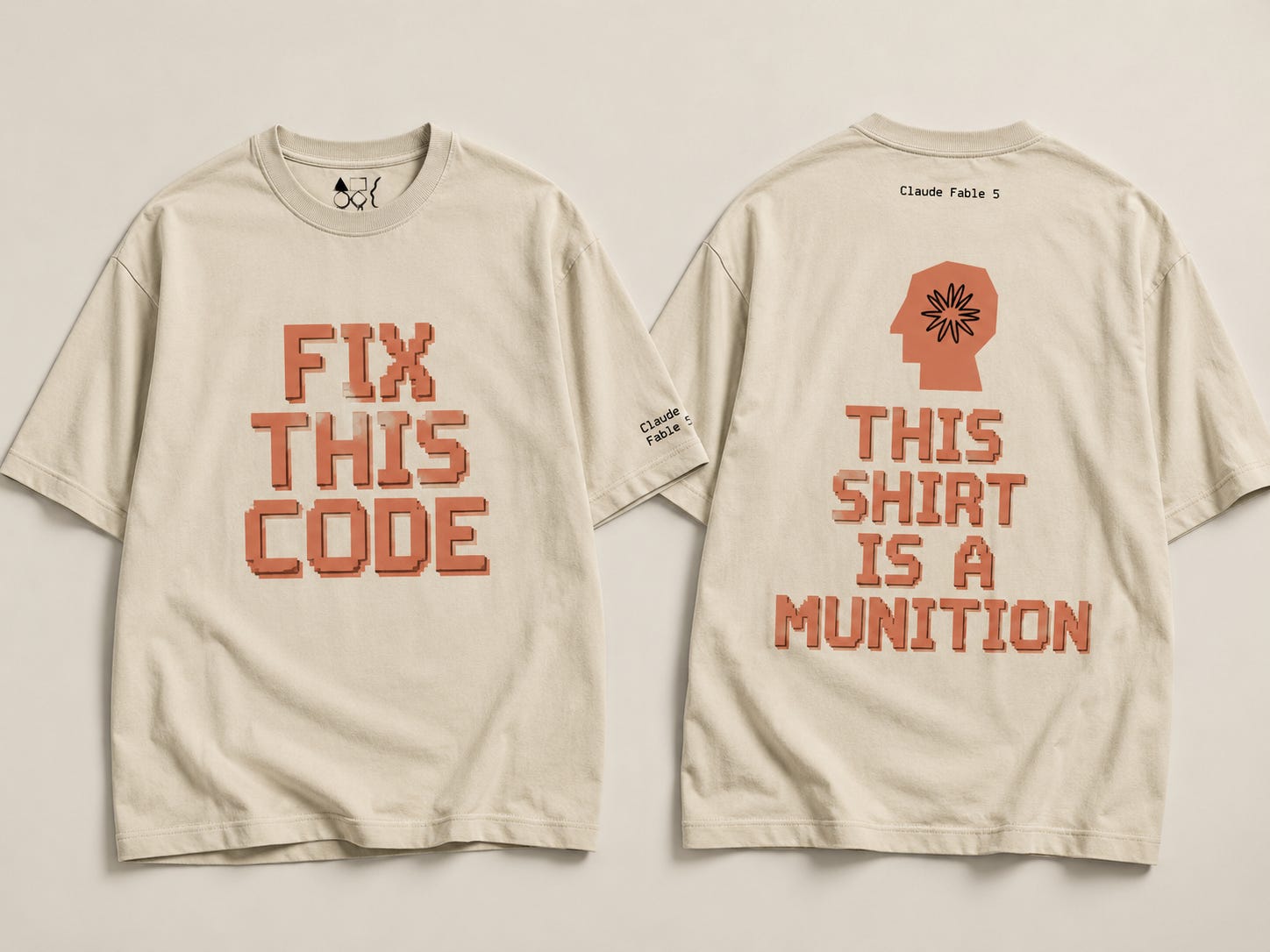
There’s some precedent for banning things through export controls. Outside the US, Japan placed military export restrictions on the Playstation 2 because the processor was too powerful (LA Times, 17/Apr/2000). Inside the US, the list looks like this:
Encryption as munitions (1970s–1996). Strong crypto classified as a weapon under ITAR, establishing that software can be a controlled item. (Wiki, 15/Apr/1996)
PGP investigation (1993–96). Zimmermann investigated for releasing encryption software publicly; dropped without charges. (MIT, 12/Jan/1996)
Deemed export rule, 15 CFR §734.13. Releasing controlled tech to a foreign national on US soil = export to their home country. The mechanism that forced Anthropic’s global shutdown. (Cornell, 01/Jun/1994)
Bernstein v. US Dept. of State (1996). Court held source code is First Amendment-protected speech. Open question whether model weights qualify. (Wiki, 15/Apr/1996)
EO 13026: encryption to Commerce (1996). Clinton moved crypto from the Munitions List to the Commerce Control List, creating the BIS authority used against Fable 5. (GovInfo, PDF, 19/Nov/1996)
J. Reece Roth conviction (2008). Professor jailed four years for letting foreign students access Air Force research. First deemed-export prosecution of an individual. (DOJ, 03/Sep/2008)
October 2022 chip controls. BIS restricted AI chip exports to China. Until Fable 5, controls had only targeted hardware. (BIS, 07/Oct/2022)
BIS AI Diffusion Framework, ECCN 4E091 (2025). Export control category for closed-weight models trained above 10²⁶ cumulative FLOP. Included employee carve-outs the Fable 5 directive bypassed. (Fed Register, 15/Jan/2025)
Trump EO: AI Innovation and Security (2026). Voluntary pre-release cyber review for frontier models. Fable 5 launched seven days later without it. (White House, 02/Jun/2026)
Fable 5 directive (2026). Commerce ordered Anthropic to block all foreign-national access to Fable 5 and Mythos 5. First export control on a live commercial LLM, pulled worldwide within 90 minutes. (Anthropic, 12/Jun/2026)
Even without government intervention, we (the public) have also been subject to massive delays before we’re ‘allowed’ to access frontier models. Here are just a few of the state-of-the-art model delays I’ve logged, where the time between ‘available in lab’ and ‘general availability to the public without approval’ is significant. These are delays to accessing intelligence itself:
GPT-2 1.5B. Delayed by 264 days. (14/Feb/2019–5/Nov/2019)
GPT-3. Delayed by 538 days. (29/May/2020–18/Nov/2021)
DeepMind Chinchilla. Delayed by 1,539+ days and counting. (29/Mar/2022–)
DeepMind Gato. Delayed by 1,495+ days and counting. (12/May/2022–)
GPT-4 (ChatGPT). Delayed by 195 days. (31/Aug/2022–14/Mar/2023)
GPT-4 (API). Delayed by 309 days. (31/Aug/2022–6/Jul/2023)
Claude Fable 5. Delayed by 105 days. (24/Feb/2026–9/Jun/2026)
And with the US Government’s AI executive order now asking AI labs to submit frontier models for government review at least 30 days before release, the public will be guaranteed a new minimum wait time for frontier intelligence, while China and the world marches on.
The current US administration is set to remain in office until 20/Jan/2029, so will likely see us through both AGI and the beginning of ASI. Unfortunately, they’re closely following the playbook set out by the AI-2027 scenario research team, who wrote about a fictional conglomerate of labs like Anthropic they called ‘OpenBrain’:
Security clearances filtering out non-Americans from AI work (May 2027 section):
The OpenBrain-DOD contract requires security clearances for anyone working on OpenBrain’s models within 2 months. These are expedited and arrive quickly enough for most employees, but some non-Americans, people with suspect political views, and AI safety sympathizers get sidelined or fired outright.
Government withholding models from allies (May 2027 section):
America’s foreign allies are out of the loop. OpenBrain had previously agreed to share models with UK’s AISI before deployment, but defined deployment to only include external deployment, so London remains in the dark.
The AI-2027 scenario often imagined export controls applied to hardware (chips) rather than to model access itself. What has happened with the Claude Fable 5 suspension is more aggressive than anything in the scenario: the US Commerce Department applied export control authority directly to a commercially available model that had already been delayed by 3½ months, pulling it from paying customers worldwide with just 90 minutes notice.
We are certainly living in interesting times. The question now is whether the Claude Fable 5 ban stays as a ‘one-off’ exception, or becomes the template for controlling public access to intelligence from upcoming frontier models like GPT-6, Gemini 4, and others.
Expert calls: If you or your team would like to have an expert call about this, please contact us by replying to this email, and we’ll get you set up.
All my very best,
Alan
LifeArchitect.ai