
The Memo - 14/Feb/2026
Global AI adoption @ 16.3%, GPT-5.3-Codex, new AI paper every 9 minutes, and much more!

To:      US Govt, major govts, Microsoft, Apple, NVIDIA, Alphabet, Amazon, Meta, Tesla, Citi, Tencent, IBM, & 10,000+ more recipients…
From:    Dr Alan D. Thompson <LifeArchitect.ai>
Sent:    14/Feb/2026
Subject: The Memo - AI that matters, as it happens, in plain English
AGI:     97%
ASI:     0/50 (no expected movement until post-AGI)
Sequoia Capital (14/Jan/2026):
‘Today [in early 2026], your agents can probably work reliably for ~30 minutes. But they’ll be able to perform a day’s worth of work very soon – and a century’s worth of work eventually. What can you achieve when your plans are measured in centuries? A century is 200,000 clinical trials no one’s cross-referenced.
A century is every customer support ticket ever filed, finally mined for signal.
A century is the entire US tax code, refactored for coherence.’
Well, the lull is certainly over. Aussies talk about a business shutdown between Melbourne Cup Day and Australia Day (early November until late January). Now we’re definitely back. This year has already seen a new paper on AI published every nine minutes (more detail below). This edition’s thumbnail is a video frame from Kling 3.0, discussed in the Toys to Play With section. The latest ALPrompt (2026H1) has been verified and is now available.
The winner of The Who Moved My Cheese? AI Awards! for Feb/2026 is Google DeepMind-affiliated mathematicians who said: ‘To date [Feb/2026], hype notwithstanding, the impact of artificial intelligence on pure mathematics research has been limited… [our results] do not indicate that artificial intelligence has matched, or will match, the capabilities of human mathematicians… In any specific subject, frontier models have much shallower knowledge than a domain expert…’
As a reminder, humans are really not very good at comprehending the extreme (and extremely rapid pace of) intelligence in today’s frontier AI models. Just last year, the smartest person in the world, mathematician Prof Terence Tao (Sidenote: Terry and I went to the same university here in Adelaide. He was a few years ahead of me, attending at the age of nine.) asserted that frontier models would not outdo human mathematicians in the mid-2025 International Math Olympiad (IMO) competition. He said ‘It won’t happen this [upcoming 2025] IMO. The [frontier model] performance is not good enough in the time period’ (15/Jun/2025). Just four weeks later, internal LLMs from OpenAI and Google both achieved gold medal-level performance on that exam (under the same rules as human contestants: two 4.5-hour exam sessions, no tools or internet).
Contents
The BIG Stuff (Paper stats, global AI adoption @ 16.3%, GPT-5.3-Codex…)
The Interesting Stuff (MD for agents, xAI exodus, Waymo world model, Billboard AI…)
Policy (Pentagon AI, Chinese AI progress, Chinese BAT firms, US data center pause…)
Toys to Play With (All system prompts, Kling 3.0, SFX for agents, agent embodiment…)
Things I’ve Been Thinking About (The pace of change really is staggering.…)
Next (Roundtable…)
The BIG Stuff
Exclusive: AI papers published per day (Feb/2026)

Remember this chart from Sep/2022? It shows the number of AI papers published per month since the 1990s. It was designed by a group of researchers from Max Planck and elsewhere.1
In a previous analysis (The Memo edition 5/Sep/2024), I looked at 20,759 AI papers published in the first eight months of 2024, finding a new paper on AI was published every 16 minutes and 52 seconds.
We can redo this for the start of 2026. There were 6,354 AI papers submitted to arXiv.org in the first 43 days of 2026 (my calcs via GPT). In mid-February 2026:
1 new paper on AI is now published every 9 minutes and 45 seconds. That means papers are coming out about 1.7 times faster than before. Put differently, the publication rate has increased by about 73%.
If we wanted to read all these papers, we’d have to read 148 papers per day.
If we read for 8 hours per day (including weekends), we’d have to read one AI paper every 3 minutes and 15 seconds. Good luck!
I also tracked 15 new large language models announced last month (Jan/2026), and 7 so far this month (Feb/2026). That’s consistent with the last few years of a major new model release every 48 hours.
See them on the Models Table: https://lifearchitect.ai/models-table/
Microsoft: Global AI adoption in 2025: a widening digital divide (8/Jan/2026)
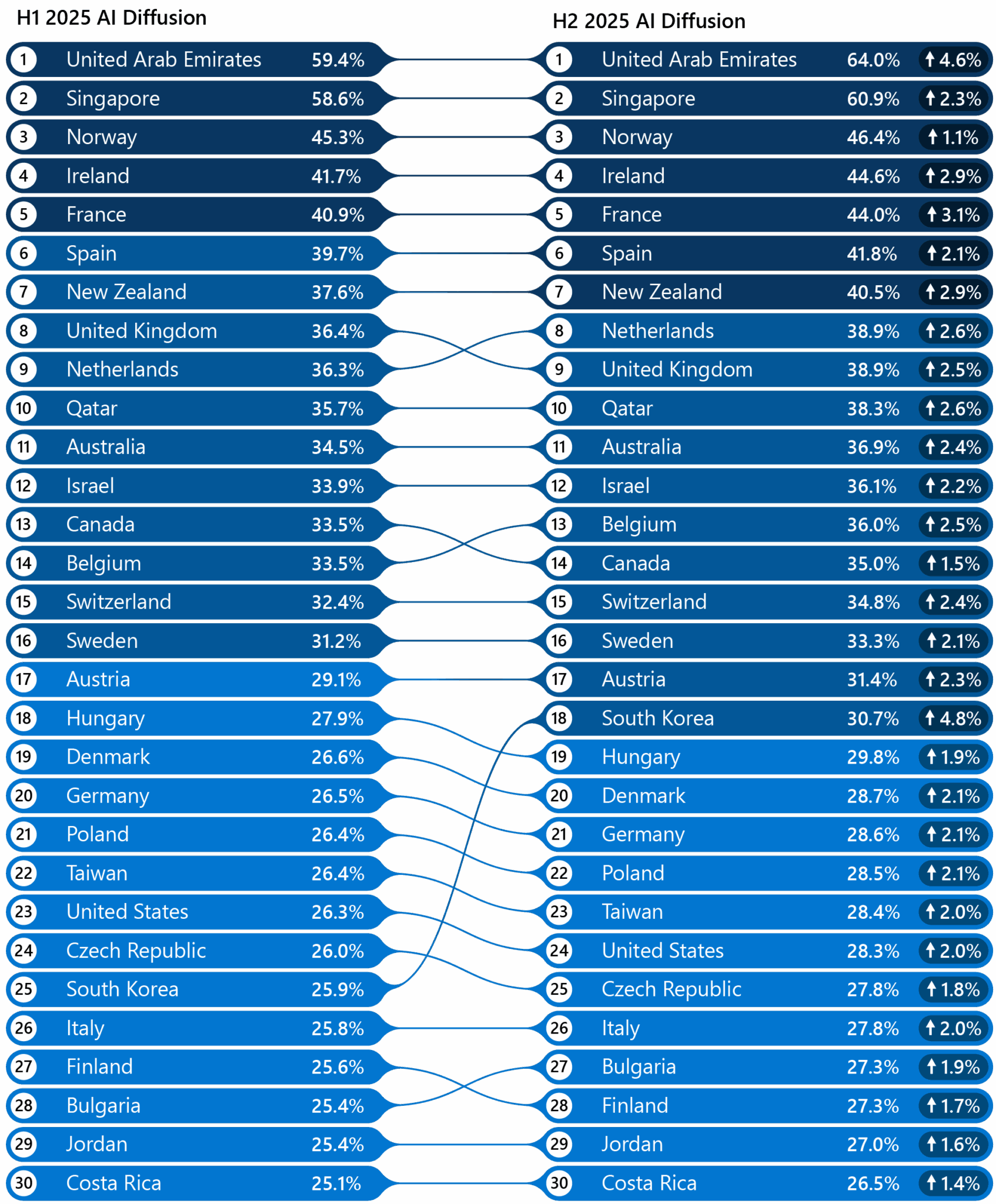
Roughly one in six people worldwide now use generative AI tools, with global adoption reaching 16.3% of the world’s population in H2 2025. The UAE leads the world at 64% adoption, followed by Singapore at 61%, while the US dropped to 24th place at 28%, proving that ‘leadership in innovation and infrastructure, while critical, does not by themselves lead to broad AI adoption.’ DeepSeek’s open-source, zero-cost model surged across Africa, China, Russia, and other markets historically underserved by Western platforms, with African usage estimated at 2-4x higher than other regions, signaling that the next billion AI users may emerge from the Global South.
Sidenote: It seems a so long ago, but it was Oct/2022 when I delivered the opening keynote to 4,000+ Google, Microsoft, IBM, and other software developers at Devoxx in Belgium. I asked ‘How many people here have used an AI code generator?’ At that time, less than half of developers had ever used AI to write code. Today that figure may hit 100% (as is now the case at OpenAI and Anthropic, Spotify, and others). It took just three years to push AI adoption for professional software developers from 50% ➜ ~100%. I wonder how long it will take to push AI adoption for all humans from 16% ➜ ~100%.
Read more via Microsoft.
Anthropic Claude Opus 4.6 (Feb/2026)
Anthropic Claude Opus 4.6 demonstrates better coding, deeper reasoning, and a 1M token-context window. Pricing stays at US$5/US$25 per million tokens. We detailed this model in a special edition last week.

OpenAI GPT-5.3-Codex (5/Feb/2026)
About 20 minutes after the release of Claude Opus 4.6, OpenAI pushed the button on GPT-5.3-Codex, their most capable agentic coding model to date, advancing coding performance and reasoning capabilities while running 25% faster than its predecessor. This model leads the charge in ‘recursive self-improvement’ (wiki), and the ASI checklist has been updated accordingly. OpenAI wrote:
GPT‑5.3‑Codex is our first model that was instrumental in creating itself. The Codex team used early versions to debug its own training, manage its own deployment, and diagnose test results and evaluations…
Read more: https://openai.com/index/introducing-gpt-5-3-codex/
See it on the Models Table: https://lifearchitect.ai/models-table/
The Interesting Stuff
The New Yorker: What is Claude? Anthropic doesn’t know, either (9/Feb/2026)
I enjoyed reading the vivid verse of The New Yorker author who looked inside Anthropic offices in California to understand more about AI. The 10,000-word piece covers a lot about Anthropic, including how ‘Project Vend’ gave Claude ownership of an office vending machine to test real-world business agency, where it hallucinated Venmo payments, claimed to visit the Simpsons’ home address at 742 Evergreen Terrace, designed unauthorized branded merch, and lost 17% of its net worth in a single-day tungsten cube fire sale.
Sidenote: The article notes that Anthropic’s ‘paranoia extends to a near-total ban on branded merch. Such extreme operational security is probably warranted… A placard at the office’s exit reminds employees to conceal their badges when they leave.’ In The Memo edition 1/May/2024, I compiled quotes from AI founders about their fears of assassination, and I believe this risk is increasing as we progress to superintelligence.
Read more via The New Yorker.
The Memo features in recent AI papers by Microsoft and Apple, has been discussed on Joe Rogan’s podcast, and a trusted source says it is used by top brass at the White House. Across over 100 editions, The Memo continues to be the #1 AI advisory, informing 10,000+ full subscribers including RAND, Google, and Meta AI. Full subscribers have complete access to all 25+ AI analysis items in this edition!
OpenAI GPT-5.2 proposed and proved a novel result in theoretical physics (13/Feb/2026)