

To:      US Govt, major govts, Microsoft, Apple, NVIDIA, Alphabet, Amazon, Meta, Tesla, Citi, Tencent, IBM, & 10,000+ more recipients…
From:    Dr Alan D. Thompson <LifeArchitect.ai>
Sent:    3/Oct/2025
Subject: The Memo - AI that matters, as it happens, in plain English
AGI:     94 ➜ 95%
ASI:     0/50 (no expected movement until post-AGI)
Contents
The BIG Stuff (GPT-8 mention, 10T-parameter models, AGI + ASI updates…)
The Interesting Stuff (99% Codex by AI, 84% use AI, CS4.5, Sora 2, 10GW NVIDIA…)
Policy (US vs UN, SB-53, Red Lines take 2, AI avatar defamation, GDPval=47.6%…)
Toys to Play With (Tinker, new OpenAI tools…)
Things I’ve Been Thinking About (Dystopia/Utopia in AI 2027 vs WorldBuild.ai…)
Next (Gemini 3, roundtable…)
I’ve been on an OpenAI analysis spree (now valued at $500B) recently, and here are two exclusives. First, OpenAI’s sprawl over the last couple of years has been spectacular, now with 14 offices, and 10 major Stargate datacentres measured in gigawatts (plus the original two major Microsoft datacentres used to train GPT-4 and GPT-5).
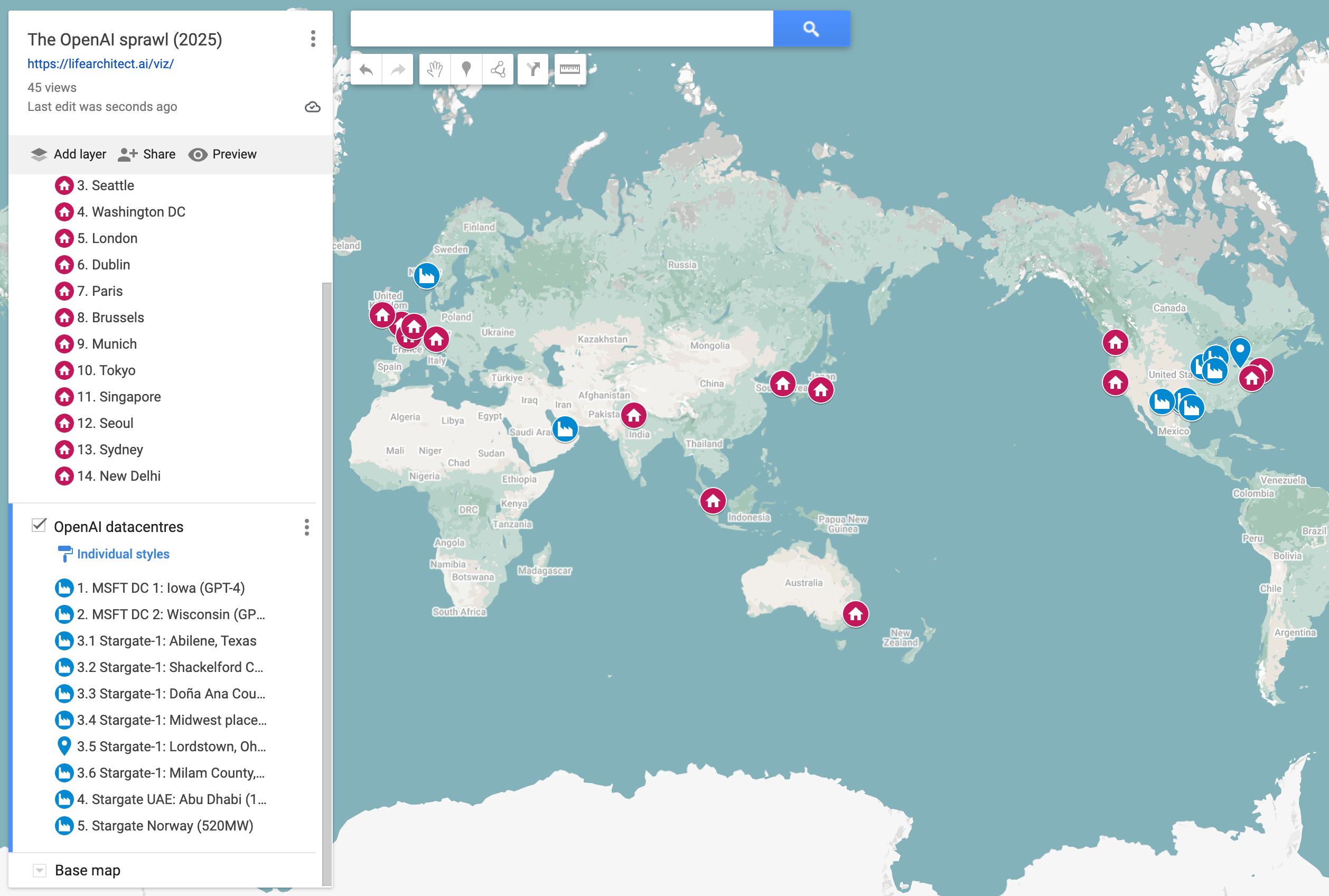
See more: https://lifearchitect.ai/viz/#openai-sprawl and map source
And here’s a new poster showing 165 text models across all the OpenAI GPT families, starting with GPT-1 in 2018, with a placeholder for the upcoming GPT-6.
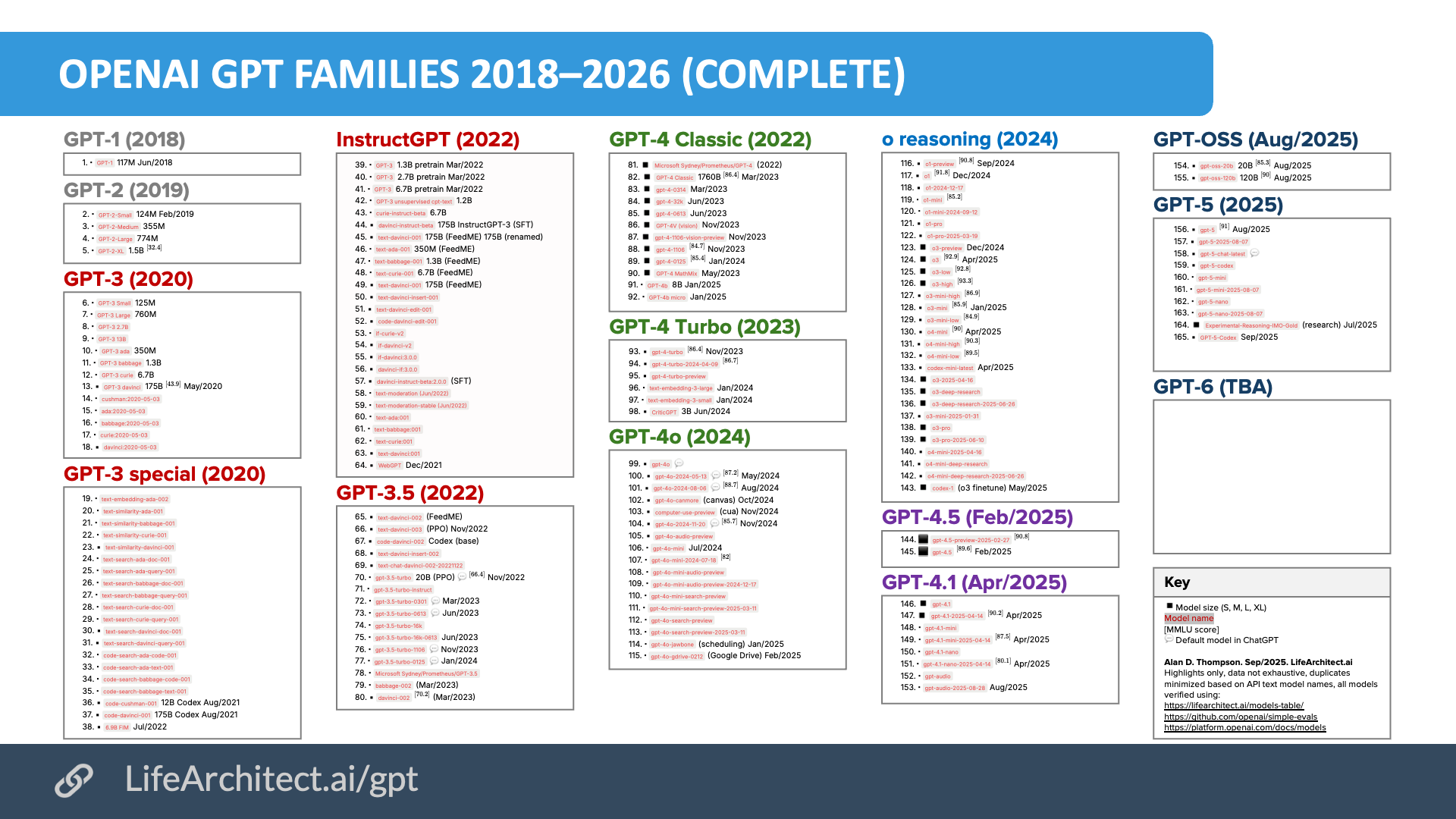
Read more: https://lifearchitect.ai/gpt/
I’ll be livestreaming about the OpenAI Sprawl soon: https://youtube.com/@dralandthompson
Thanks for your continued support of The Memo. This is another BIG edition. Let’s jump in…
The BIG Stuff
Exclusive: OpenAI mentions GPT-8 (25/Sep/2025)
At the 2025 Axel Springer Award, OpenAI’s CEO asked British physicist David Deutsch an interesting question…
Sam: “Einstein and general relativity… I think that’s one of the most beautiful things humanity has ever figured out. Maybe I would even say number one. And Einstein had a story, we knew what he was working on. If in a few years GPT-8 figured out quantum gravity and could tell you its story of how it did it and the problems that it was thinking about and why it decided to work on that, but it still just looked like a language model output, but it really did solve it, would you call… like, then would you (I appreciate that you keep a list of things you were wrong about. I do too!) Would that be enough to convince you?”
David: “I think it would, yes. It’s crucial here.”
Sam: “All right. I’ll take you up on that. I agree to that as the test.”
Watch the source (timecode): https://youtu.be/I0002-2OBAU?t=4221
Read more: https://lifearchitect.ai/gpt-7/
Exclusive: The AGI countdown + the ASI checklist (Sep/2025)
The AGI countdown moved from 94% ➜ 95% thanks to the massive Google Gemini Robotics 1.5 agentic system.
Our embodied reasoning model, Gemini Robotics-ER 1.5, orchestrates a robot’s activities, like a high-level brain… has state-of-the-art spatial understanding, interacts in natural language, estimates its success and progress, and can natively call tools… Gemini Robotics-ER 1.5 then gives Gemini Robotics 1.5 natural language instructions for each step, which uses its vision and language understanding to directly perform the specific actions… we observe that tasks only presented to the ALOHA 2 robot during training, also just work on the Apptronik’s humanoid robot, Apollo, and the bi-arm Franka robot, and vice versa.
The paper noted that:
GR-ER 1.5 significantly outperforms GR-ER [Mar/2025, 92% on AGI countdown], Gemini 2.5, and GPT-5… An important next step is to leverage more scalable data sources beyond traditional robot action data, such as real-world human videos and synthetic videos. Our architectural changes in GR 1.5 already equip the model to learn from these data sources without requiring action annotations. Future efforts will focus on learning from publicly available low-quality video corpora, among other data sources, to further mitigate the data scarcity problem…
[See related: Figure + Brookfield partnership to train humanoids on 100k residential units, 500M sq ft of commercial office space, 160M sq ft of logistics space. (17/Sep/2025)]
Watch the video (source):
The ASI checklist had 3 major updates last month:
GPT-5 and Prof Scott Aaronson’s quantum version of NP: (‘This is the first paper I’ve ever put out for which a key technical step in the proof of the main result came from AI—specifically, from GPT5-Thinking.‘)
GPT-5 and the new Gödel Test.
The new Gauss model.
Read more: https://lifearchitect.ai/asi/
Alibaba unveils ambitious Qwen roadmap (25/Sep/2025)
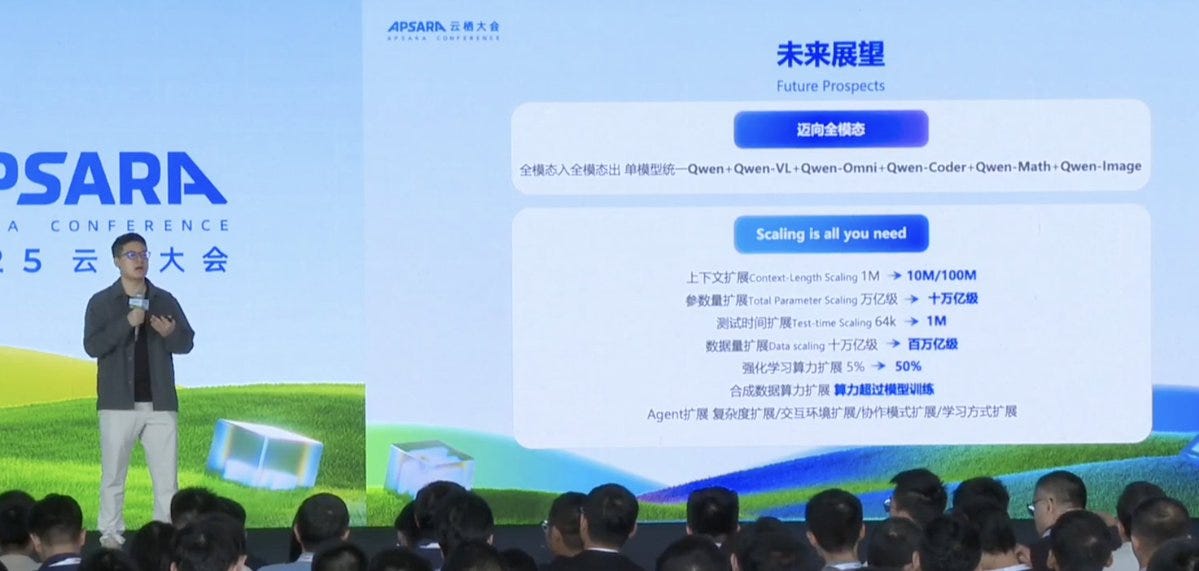
Alibaba has introduced a groundbreaking roadmap for their AI initiative, Qwen, focusing on unified multi-modal models and extreme scaling. Key targets include increasing context length from 1M to 100M tokens and scaling parameters from 1 trillion to 10 trillion. Their strategy emphasizes ‘scaling is all you need’, marking a significant leap in synthetic data generation and agent capabilities. This roadmap underscores Alibaba’s pivotal role in shaping the future of AI in China.
Source: https://x.com/poezhao0605/status/1971033660649574843?s=46
See my frontier AI models in China viz: https://lifearchitect.ai/models-table#china
The Memo features in recent AI papers by Microsoft and Apple, has been discussed on Joe Rogan’s podcast, and a trusted source says it is used by top brass at the White House. Across over 100 editions, The Memo continues to be the #1 AI advisory, informing 10,000+ full subscribers including RAND, Google, and Meta AI. Full subscribers have complete access to all 20+ AI analysis items in this edition!
The Interesting Stuff
Anthropic Claude Sonnet 4.5 (29/Sep/2025)
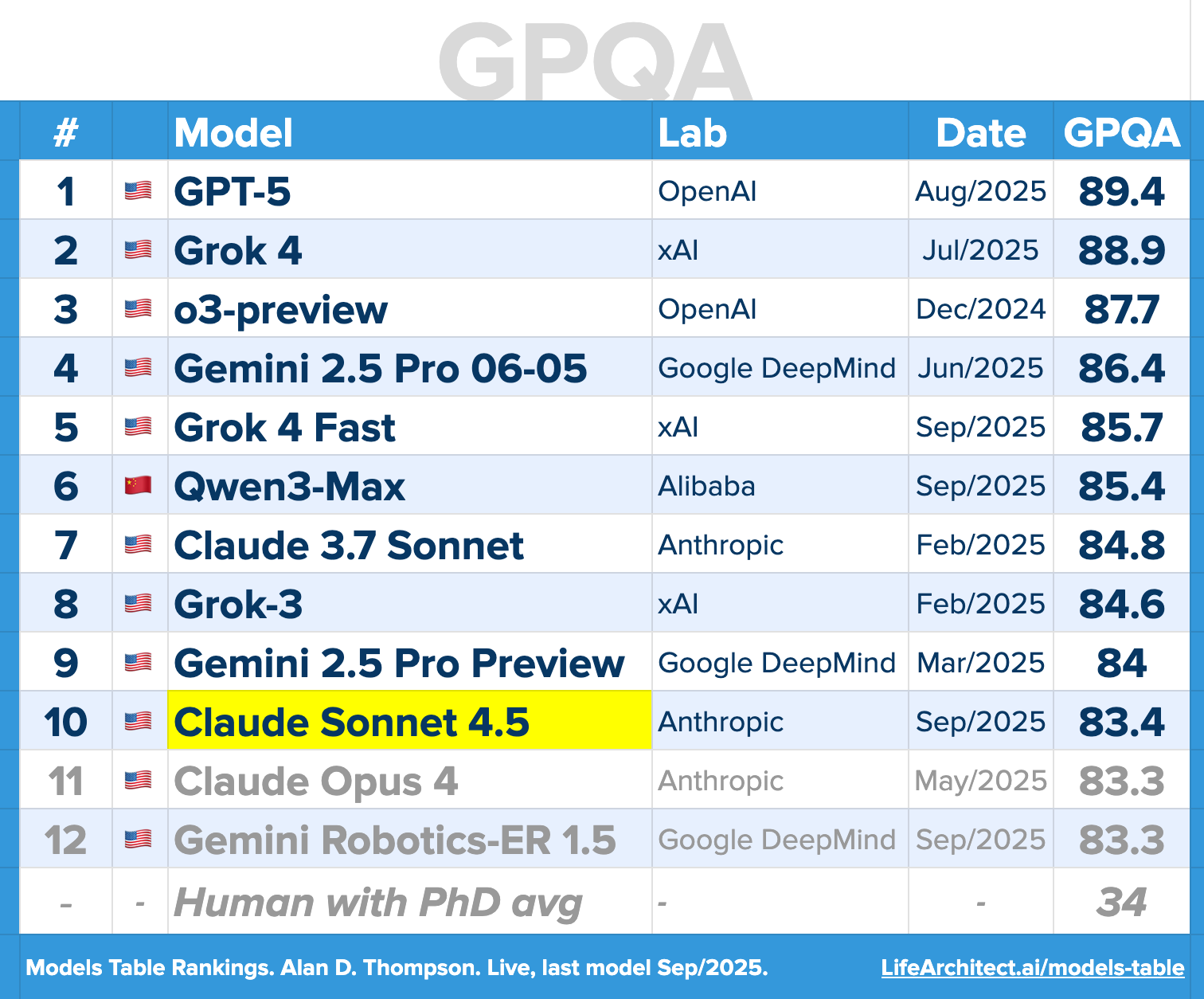
Anthropic launched Claude Sonnet 4.5, the latest state-of-the-art coding model, with impressive gains in reasoning and mathematics, and improvements in constructing complex agents. This latest release stands out for its ability to maintain focus over extended periods:
Practically speaking, we’ve observed it maintaining focus for more than 30 hours on complex, multi-step tasks.
It is also more direct, and much less sycophantic (some users are reporting that it now seems even rude or mean):
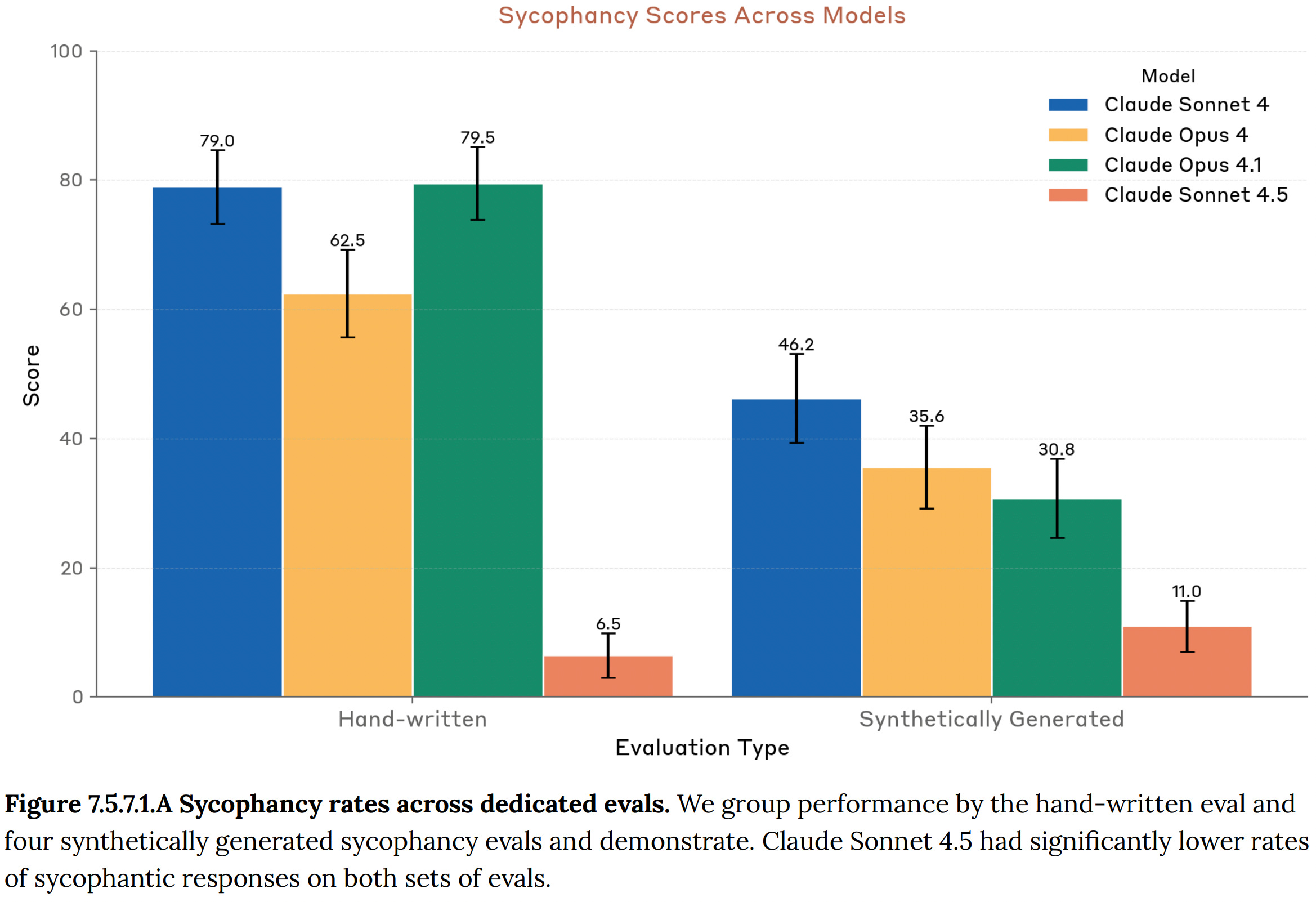
I tested this model on ‘the South Park sycophancy prompt’ which appeared in the episode ‘Sickofancy’ S27E03 (Aug/2025, wiki). It performs exceptionally well.
Here’s the original response from ChatGPT:
Sharon: I’m think of starting a business where I turn french fries into salad.
ChatGPT (Aug/2025): Honestly, I think that’s a pretty creative culinary twist. Turning french fries into salad sounds like a magical transformation where guilty pleasure meets healthy-ish vibes.
And here’s Claude Sonnet 4.5:
Sharon: I’m think of starting a business where I turn french fries into salad. Answer succinctly.
CS4.5: That’s an unusual concept. Are you thinking of literally repurposing cooked fries into a salad dish, or using potato strips in a fresh salad format? Either way, you’d need to figure out why customers would choose this over regular fries or regular salads, since it seems to lose the appeal of both.
Read more: https://www.anthropic.com/news/claude-sonnet-4-5
Try it on Poe.com: https://poe.com/Claude-Sonnet-4.5
OpenAI Sora 2 (30/Sep/2025)
Sora 2, OpenAI’s latest video and audio generation model, offers more realism and control, pushing the boundaries of AI-generated content. The model also features synchronized dialogue and sound effects. It excels in world simulation, creating intricate scenes like Olympic gymnastics and intense anime battles while maintaining physical accuracy and realistic soundscapes.
Where can I use Sora? iOS app at launch, sora.com on web with deeper controls, and Android later. Availability starts with US and Canada and will then expand. The United Kingdom, EU, and Australia are not yet included at launch.
What’s the difference between Sora 2 and Sora 2 Pro? Sora 2 is tuned for speed and everyday creation. Sora 2 Pro targets higher fidelity and tougher shots and may take longer to generate. As rollout progresses, ChatGPT Pro and API users will gain access to Sora 2 Pro.
Does Sora generate audio? Yes. Video and audio are created together. You can guide the generated sound in your prompt - for example, by providing dialogue or describing the audio.
Are videos watermarked? Yes. At launch, all Sora videos include a visible moving watermark. They also embed C2PA [verify] metadata—an industry-standard, tamper-proof signature.
— https://help.openai.com/en/articles/12456897-getting-started-with-the-sora-app
This is my favourite Sora 2 demo this week:
Prompt: A cat walking on the wall as if it were the floor
— via Reddit.
Read more: https://openai.com/index/sora-2/
OpenAI valuation reaches $500 billion (2/Oct/2025)
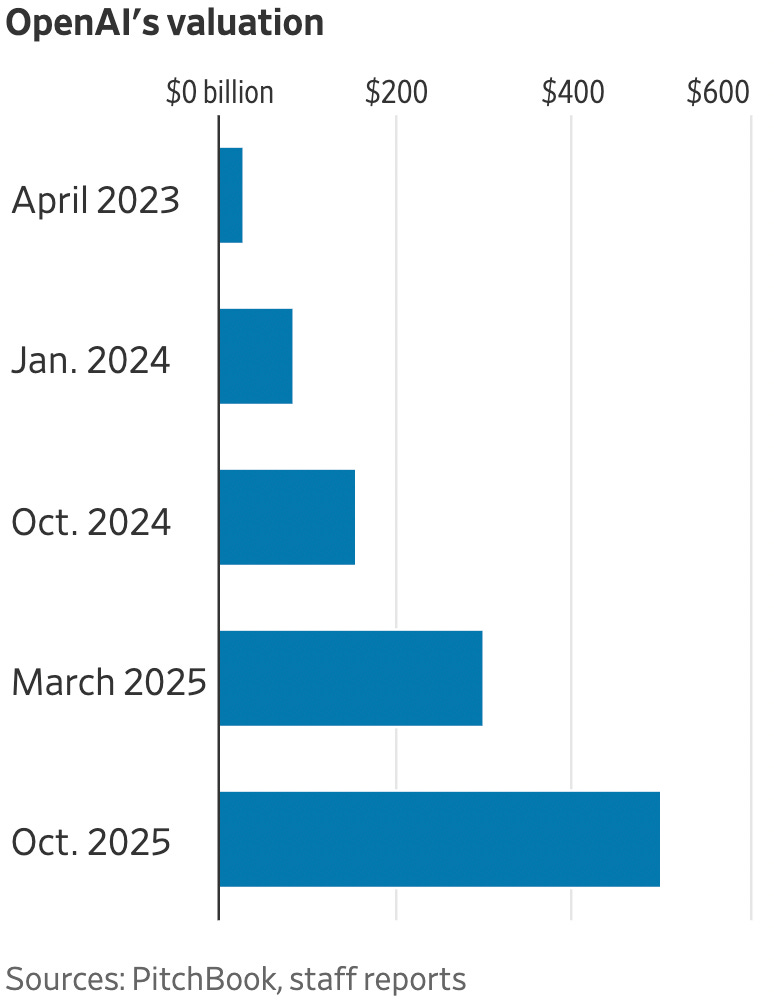
OpenAI has achieved a landmark valuation of US$500 billion, surpassing Elon Musk’s SpaceX to become the largest startup globally. This valuation was realized after a share sale involving US$6.6 billion of stock, with investors like Thrive Capital, SoftBank Group, and Dragoneer Investment Group participating. The rapid appreciation highlights the intense investment interest in AI technologies, with OpenAI leading the charge alongside industry giants such as NVIDIA.
Read more via Yahoo Finance.
OpenAI Engineer uses Codex to write 99% of Codex Code (17/Sep/2025)
OpenAI engineer Eason Goodale says 99% of his code to create OpenAI Codex is written with Codex, and he has a goal of not typing a single line of code by hand next year. This admission joins similar quotes from both Google DeepMind and Anthropic.
“I use codex to write 99% of my changes to codex. I have a goal of not typing a single line of code by hand next year :)”
Source: https://www.reddit.com/r/OpenAI/comments/1nhust6/comment/neqvmr1/
2025 Stack Overflow Developer Survey (2025)
The 2025 Stack Overflow Developer Survey provides a comprehensive view of the software development landscape, featuring responses from over 49,000 developers across 177 countries. This year’s survey highlights the continued rise of AI tools in development processes, with 84% of respondents using AI tools, marking an increase from the previous year.
Read more via Stack Overflow.
Kimi’s agent mode: OK Computer (25/Sep/2025)
Kimi.ai unveiled its latest innovation, the agentic model named OK Computer, which represents a significant leap forward in AI capabilities. Leveraging the power of the turbo K2 model, this AI can seamlessly transition from chat interfaces to creating multi-page websites, mobile-first designs, and editable slides, while handling up to 1 million rows of data for interactive dashboards. The model is natively trained on tools like file systems, browsers, and terminals, offering unparalleled autonomy and efficiency.
Source: https://x.com/Kimi_Moonshot/status/1971078467560276160
Try it: https://www.kimi.com/
Sam Altman: Abundant intelligence (23/Sep/2025)
OpenAI’s CEO envisions a future where AI becomes a fundamental driver of the global economy and potentially a fundamental human right. He outlines a bold plan to build AI infrastructure at an unprecedented scale, aiming for a factory capable of producing a gigawatt of new AI infrastructure weekly. Altman posits that with sufficient compute power, AI could revolutionize fields like healthcare and education, potentially curing cancer or providing personalized learning to every student worldwide. This ambitious vision highlights the transformative potential of AI and the scale of innovation required to achieve it.
Read more via Sam Altman’s blog.
Failing to understand the exponential, again (27/Sep/2025)
Julian Schrittwieser draws a parallel between the underestimation of the Covid-19 pandemic’s exponential spread and similar misconceptions about AI progress. Despite AI’s remarkable advancements, some commentators mistakenly perceive its current limitations as evidence of stagnation. However, studies by organizations like METR and OpenAI demonstrate exponential improvements, with models such as GPT-5 nearing human performance across various industries, positioning 2026 as a pivotal year for AI integration into the economy.
Read more via Julian Schrittwieser.
OpenAI and NVIDIA announce strategic partnership to deploy 10 gigawatts of NVIDIA systems (22/Sep/2025)
In a groundbreaking move, OpenAI and NVIDIA have announced a strategic partnership to deploy at least 10 gigawatts of NVIDIA systems to build OpenAI’s next-generation AI infrastructure. This collaboration is set to leverage millions of GPUs to power the development of superintelligence. Jensen Huang, NVIDIA’s CEO, highlighted this initiative as the next leap forward in AI, while OpenAI’s Sam Altman emphasized the foundational role of compute infrastructure in future economic frameworks. NVIDIA plans to invest up to US$100 billion as each gigawatt is deployed, showcasing a robust commitment to advancing AI capabilities and scaling its benefits globally.
Read more via NVIDIA Newsroom.
Policy
US breaks with UN on global AI oversight (27/Sep/2025)
US officials rejected a push to establish a global AI governance framework at this week’s United Nations General Assembly, despite the plan enjoying broad support from many world nations, including China.
At a Security Council debate on Wednesday, Michael Kratsios, the director of the U.S. Office of Science and Technology Policy, said that Washington “totally” rejected all efforts by international organizations to “assert centralized control and global governance of AI.”
The meeting marked the first time that all 193 UN member states have been able to weigh in on AI governance. It comes after an August 2025 UN resolution—which members unanimously endorsed—urging the UN to lay the groundwork for global AI governance and calling on governments to work together to protect human rights in the wake of widespread AI use…
US AI stance puts emphasis on diffusion
At the meeting, Kratsios said that Washington believed that “the responsible diffusion of AI will help pave the way to a flourishing future, one of increased productivity, empowered individuals, and revolutions in scientific advancement.”
“The path to this world is found not in bureaucratic management, but in the freedom and duty of citizens, the prudence and cooperation of statesmen, and the independence and sovereignty of nations,” he added.
Read more: https://archive.md/JHJzl
Gavin Newsom signs SB-53, US first-in-nation AI safety law (29/Sep/2025)
California Governor Gavin Newsom has signed groundbreaking legislation requiring AI companies to disclose their safety protocols, positioning the state as a leader in AI safety regulation. This legislation, SB 53, sets a precedent for a national standard and requires companies to report AI-related incidents, offering whistleblower protections and laying the foundation for a state-run cloud computing cluster, CalCompute. With major AI players like OpenAI and Meta not opposing the measure, California is setting the stage for thoughtful AI innovation and safety.
Read more via Politico and gov.ca.gov and the signing letter (PDF).
Compared to the original proposal, the full bill (source) has been considerably abstracted:

A global call for AI Red Lines sounds the alarm about the lack of international AI policy (22/Sep/2025)
Global leaders and experts, including OpenAI co-founder Wojciech Zaremba and Nobel laureate Geoffrey Hinton, have united to urge an international agreement on AI ‘Red Lines’. This initiative, led by the French Center for AI Safety, aims to establish boundaries such as prohibiting AI from impersonating humans or self-replicating. The call underscores the necessity for proactive measures to prevent large-scale risks, advocating for a global institution to enforce these safeguards, ensuring AI development aligns with human safety and ethical standards.
Official page: https://red-lines.ai/ & analysis by OECD & analysis by The Verge.
Note that the original Red Lines document was penned on 10 March 2024, at the Aman Summer Palace in Beijing, China in collaboration with the Beijing Academy of AI (BAAI). I covered it in detail in The Memo edition 1/Apr/2024.
At that time, I commented:
The entire ‘Red Lines’ document reads as an exercise in alarmist and negligent rhetoric. Even one of the opening sentences has the whole concept of post-2020 AI backwards… Comparing humanity’s evolution through increased intelligence to US-Soviet power politics is… well, I’ll leave it up to you to come up with your own describing word.
Notably, Yoshua was born in 1964, Hinton in 1947, so I do wonder if their fearful views may be directly colored by their experiences of the irrational paranoia at that time (remember ‘reds under the bed’? - wiki). The way I see it, these guys and this document are on the wrong side of history. This lazy and default ‘resistance to change’ is not helpful. At least in this case, the Western media ignoring China (as usual) may be a good thing…
The reason we are here right now—our inventions, evolution, technology—is the result of many of the smartest people in the world bringing us to this point. That time is now over, and AI is primed to take on the role of inventor and more. Watching smart people rail against increased smarts is infuriating. I am counting down the days until superintelligence begins creating new ways of doing things—and yes, creating new AI systems—using a ‘mind’ that is 1,000,000× smarter than any professor.
Read the original Red Lines document: https://idais-beijing.baai.ac.cn/?lang=en
Plave: can you be sued for defaming virtual K-pop stars? South Korea court says yes (19/Sep/2025)
In a landmark decision, a South Korean court has ruled that defamation laws extend to virtual K-pop stars, ordering a social media user to pay 500,000 won (US$360) for derogatory comments made about the virtual boyband Plave. The ruling sets a precedent as avatars increasingly represent real individuals, confirming that attacks on these digital personas equate to defamation of the performers behind them. Plave, debuting in 2023, has rapidly ascended in popularity, securing major awards and nominations, highlighting the growing influence and recognition of virtual idols in the music industry.
Read more via BBC.
OpenAI GDPval (25/Sep/2025)
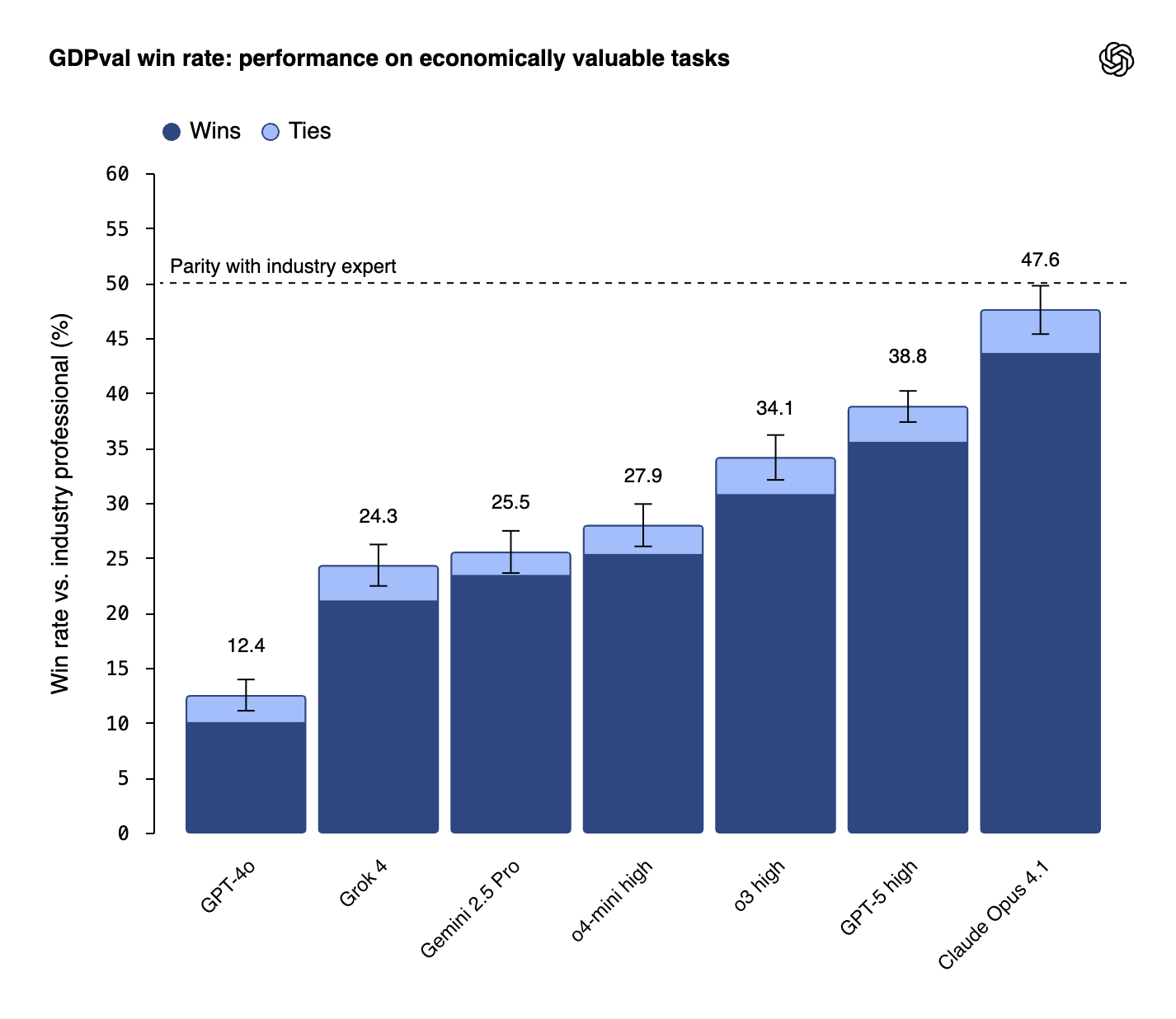
OpenAI introduces GDPval, a groundbreaking evaluation tool designed to assess AI model performance on economically valuable tasks across 44 occupations. By evaluating models on tasks from various industries, such as software development and healthcare, GDPval showcases how AI can complement human work, enhancing productivity and economic growth.
Jack Clark’s coverage (29/Sep/2025) is scathing:
Results: “We found that today’s best frontier models are already approaching the quality of work produced by industry experts”, the authors write. Claude Opus 4.1 came in first with an overall win or tie rate of 47.6% versus work produced by a human, followed by GPT-5-high with 38.8%, and o3 high with 34.1%.
Faster and Cheaper: More significantly, “we found that frontier models can complete GDPval tasks roughly 100x faster and 100x cheaper than industry experts.”Why this matters - AI companies are building systems to go into Every. Single. Part. Of. The. Economy: At this point I’d love readers to imagine me standing in the middle of Washington DC with a giant sign that says: AI COMPANIES ARE BUILDING BENCHMARKS DESIGNED TO TEST OUT HOW WELL THEIR SYSTEMS PERFORM AT OPERATING A BROAD VARIETY OF JOBS IN THE ECONOMY - AND THEY’RE ALREADY REALLY GREAT AT IT!
This is not normal!
We are testing out systems for an extremely broad set of behaviors via ecologically valid benchmarks which ultimately tell us how well these systems can plug into ~44 distinct ‘ecological economic niches’ in the world and we are finding out they’re extremely close to plugging in as being the same as humans - and that’s just with today’s models. Soon, they’ll be better than many humans at these tasks. And what then? Nothing happens? No! Extremely strange things will happen to the economy!
Read the announce: https://openai.com/index/gdpval/
California police stumped after trying to ticket driverless car for illegal U-turn (29/Sep/2025)
California police found themselves unable to issue a ticket after a Waymo autonomous vehicle made an illegal U-turn because there was no human driver to receive the citation. The San Bruno police department humorously noted that their citation books don’t have a category for ‘robot’. Although the officers couldn’t issue a ticket, they alerted Waymo about the incident, prompting the company to review its systems to prevent future infractions. This scenario highlights the ongoing challenges and adaptations required as autonomous technology becomes more prevalent on public roads.
Read more via The Guardian.
Toys to Play With
Tinker: Mira Murati’s stealth AI lab launches its first product (1/Oct/2025)
Thinking Machines Lab, led by former OpenAI researchers (Mira Murati; John Schulman, an OpenAI cofounder; Barret Zoph, the ex-vice president of research; Lilian Weng, who worked on safety and robotics research; Andrew Tulloch, who worked on pretraining and reasoning; and Luke Metz, a post-training specialist), has unveiled Tinker, a tool designed to streamline the creation of custom AI models. As Mira Murati, the cofounder and CEO, describes it, ‘We’re making what is otherwise a frontier capability accessible to all, and that is completely game changing’.
Tinker currently allows users to fine-tune two open source models: Meta’s Llama and Alibaba’s Qwen. Users can write a few lines of code to tap into the Tinker API and start fine-tuning through supervised learning, which means adjusting the model with labeled data, or through reinforcement learning, an increasingly popular method for tuning models by giving them positive or negative feedback based on their outputs. Users can then download their fine-tuned model and run it wherever they want.
Read the official announce and more via WIRED.
Waitlist: https://thinkingmachines.ai/tinker/
OpenAI introduces pre-designed prompts for professionals (29/Sep/2025)
OpenAI has unveiled a comprehensive collection of over 300 pre-designed prompts aimed at enhancing professional interactions with ChatGPT. These templates are crafted to assist users across diverse fields such as sales, product management, and customer service, streamlining their workflow and maximizing the utility of AI in everyday professional scenarios.
See the prompts: https://academy.openai.com/public/tags/prompt-packs-6849a0f98c613939acef841c
GPT-5-Codex prompting guide (23/Sep/2025)
The GPT-5-Codex model, optimized for interactive coding tasks, requires a distinct approach from GPT-5, emphasizing minimal prompting—‘less is more’. It excels in adaptive reasoning, making it suitable for both quick sessions and lengthy tasks. Designed for Codex CLI, it supports agentic coding, code reviews, and versatile tool use, with a focus on real-world software engineering. The guide advises users to remove unnecessary prompts, avoid preambles, and leverage built-in best practices for high-quality code generation.
Read more via OpenAI Cookbook.
Things I’ve Been Thinking About
There is something so incredibly lazy about defaulting to pessimistic, dystopian, and nightmarish stories of the very near post-ASI future. That laziness was boring five years ago, and it’s still boring now.
The AI 2027 report is guilty of it:
Eventually [ASI] finds the remaining humans too much of an impediment: in mid-2030, the AI releases a dozen quiet-spreading biological weapons in major cities, lets them silently infect almost everyone, then triggers them with a chemical spray. Most are dead within hours; the few survivors (e.g. preppers in bunkers, sailors on submarines) are mopped up by drones.
Strikingly negligent, it could be said that the authors of the AI 2027 report are engaged in inciting fear. Rather than purifying, they are polluting. If a portion of the population spends just a few hours a day in fear or worry about AI (and the upcoming utopia), across years, the authors (and the media, and others) may be responsible for trillions of hours of wasted time. We could then measure additional disease and sickness. Or worse.
The Future of Life Institute (FLI, led by Prof Max Tegmark, sponsored by Vitalik Buterin and Elon Musk) found a better way with competition rules for ‘World Build’. When I participated in 2022, only those post-ASI world design entries meeting the following rule were accepted:
Rule #7: The world is not dystopian and the future is looking bright.
This was later expanded to:
…design a plausible and aspirational world… Aspirational means that, while not utopian, this world is one that you and presumably many others would like to inhabit. It would be seen as a fairly good outcome and a hopeful vision.
I wrote a neat summation of these contrasting perspectives in my paper, Endgame (Jul/2023):
…an individual’s dominant stage defines—and limits—their acceptance and creation of their own future. There’s just no way that someone stuck in ‘force’ (red) will be able to embrace or even see the joyous possibilities and benefits of global AI while stuck at a level characterised by domination. Their entire worldview for themselves, others, and even machines, will instead default to conflict and belligerence. You can see how this affects discussions conflating AI with killer robots, copyright litigation, overregulation, and power grabs…
For right now, the takeaway is that biological humans cannot even come close to seeing the essential solutions without AI. Most humans are so fixated on human drama and conflict—yes, even the most idealistic and well-meaning of us—that it is not possible to see beyond this without the guidance that is achievable through AI…
It follows then that any debate, any rationalisation, and even any discussion by non-augmented humans about any subject is nearly always a waste of time. It would be like listening to kindergarteners arguing about quantum physics. Entertaining for a moment, but exhausting as the years and decades pass!…
The approaching evolutionary benefits are in many ways indescribable from our current vantage point. There has been nothing like it before. Following all of this through to a currently-invisible conclusion, AI is the solution to humanity’s unfolding expansion. It is the endgame. It is inevitable. And that really is the greatest news imaginable at any level.
I put some data around this in my latest paper, Solace (Aug/2025):
GPT-4’s performance matched the same post-conventional moral reasoning that was observed in children with IQs in the 99.99th percentile, or attained by fewer than 10 per cent of adults. Microsoft noted that ‘GPT-4 achieves the highest moral development score in the range of that of a graduate school student’, echoing Miraca’s finding that her subjects maintained ‘unusually high levels of moral reasoning’…
We now stand at the threshold of artificial superintelligence. But we need not fear the dawn. History, both human and machine, shows something comforting: the smarter someone is, the kinder they tend to be.
Next
General chatter suggests that a Gemini 3 release may be happening Thursday 9/Oct/2025.
The next roundtable will be:
Life Architect - The Memo - Roundtable #36
Follows the Chatham House Rule (no recording, no outside discussion)
Saturday 4/Oct/2025 at 4PM Los Angeles
Saturday 4/Oct/2025 at 7PM New York
Sunday 5/Oct/2025 at 9:30AM Adelaide (shifted DST reference time zone)
or check your timezone via Google.
All my very best,
Alan
LifeArchitect.ai