To: US Govt, major govts, Microsoft, Apple, NVIDIA, Alphabet, Amazon, Meta, Tesla, Citi, Tencent, IBM, & 10,000+ more recipients…
From: Dr Alan D. Thompson <LifeArchitect.ai>
Sent: 18/Aug/2025
Subject: The Memo - AI that matters, as it happens, in plain English
AGI: 94%
ASI: 0/50 (no expected movement until post-AGI)Atlassian CEO and founder Scott Farquhar (30/Jul/2025):
’AI is going to change [every country]. Every person should be using AI daily for as many things as they can. Like any new technology, it will feel awkward to start with, but every business person, every business leader, every government leader, and every bureaucrat should be using it.’
The winner of The Who Moved My Cheese? AI Awards! for Aug/2025 is Illinois, USA Governor Jay Robert "JB" Pritzker, who recently signed a bill into law banning AI in the state: ‘The people of Illinois deserve quality healthcare from real, qualified professionals and not computer programs that pull information from all corners of the internet to generate responses that harm patients.’ [Sidenote: Frontier models at this time were o3, Gemini-2.5-Pro, Claude 4…]
We have a hefty Policy section in this edition. With recent model releases, my ‘daily driver’ models have changed quite a bit. The list is updated frequently, always available to full subscribers in downloads and highlights, and shown in the Toys to Play With section near the end of this edition.
Contents
The BIG Stuff (Merge Labs BMI, Synchron BMI + iPad debut, Genie 3…)
The Interesting Stuff (Grok 4.20, Babuschkin exits, Wells Fargo, Waymo 99%…)
Policy (Anthropic copyright, police AI reports, DOGE, US vs China, GPT-5 jailbreaks…)
Toys to Play With (Models I use, Harmony response format, Eleven Music…)
Things I’ve Been Thinking About (A new compressed, international language…)
Next (Gemini 3.0, roundtable…)
The BIG Stuff
Solace: Superintelligence and goodness (4/Aug/2025)

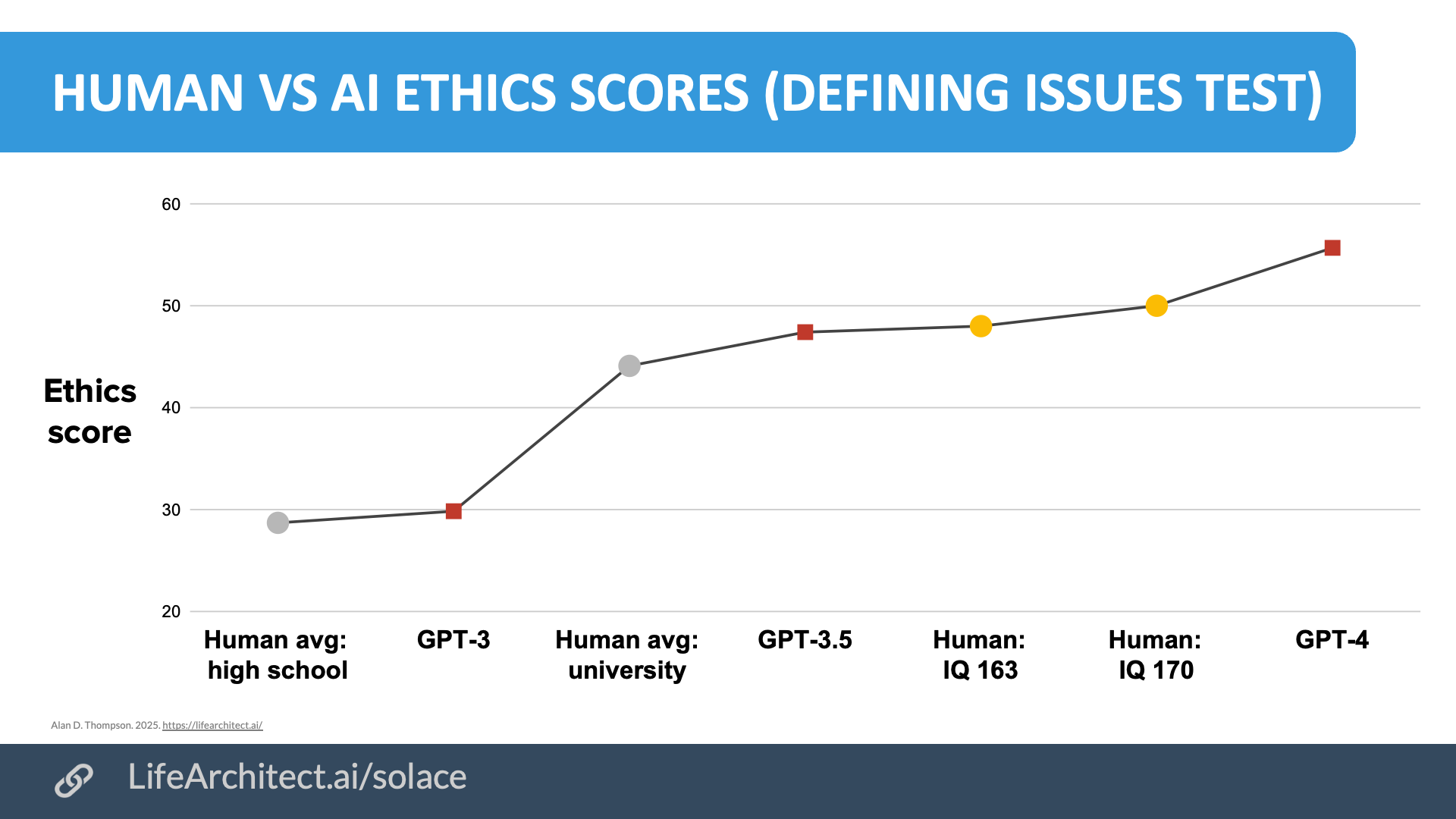
My latest paper explores the relationship between high intelligence and high ethics scores, covering both human and artificial intelligence. Exceptional intelligence systematically correlates with moral sensitivity, and LLMs now exhibit ethical reasoning akin to advanced human moral development. This convergence suggests that as AI becomes more intelligent, it also becomes more aligned with human values of fairness and kindness, offering reassurance about the future of AI.
Read the paper (with PDF and video options): https://lifearchitect.ai/solace/
Here’s the main chart based on separate studies by Microsoft and Miraca Gross:
Exclusive: Frontier AI model highlights in China (Aug/2025)
One of the benefits of extended Q&A during workshops and consulting is listening to queries and concerns from around the room. There seems to be a lot of renewed interest in Chinese models, and one of my Fortune 500 clients recently requested a keynote with a focus on this, which led to my new viz. Looking at this alongside the usual Models Table viz (the ‘big 5’ in the US), China has something more like a ‘big 16’, each model comparable with GPT.
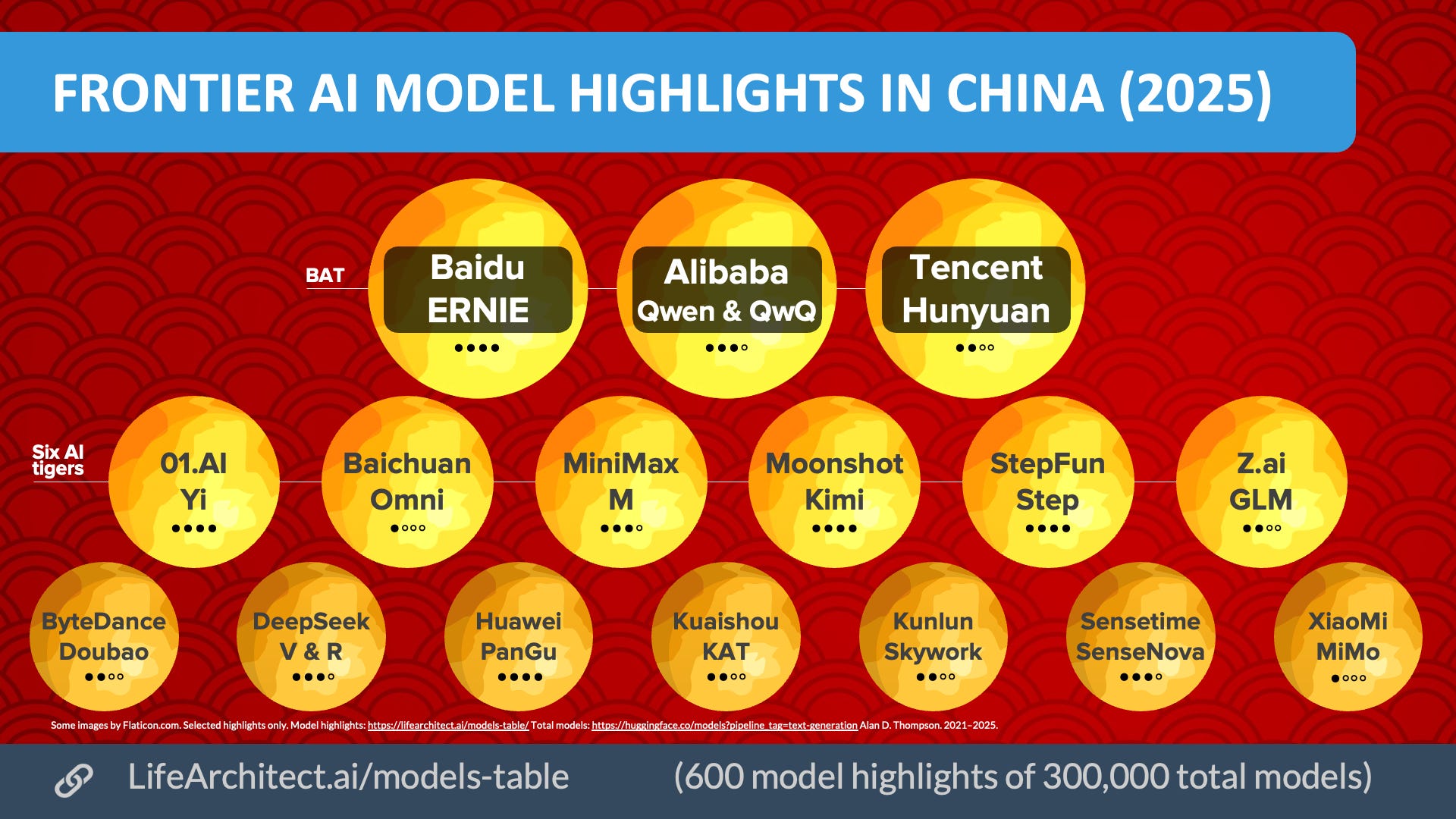
Source (with PDF option): https://lifearchitect.ai/models-table/
Synchron debuts the first thought-controlled iPad experience using Apple’s new BCI Human Interface Device protocol (4/Aug/2025)
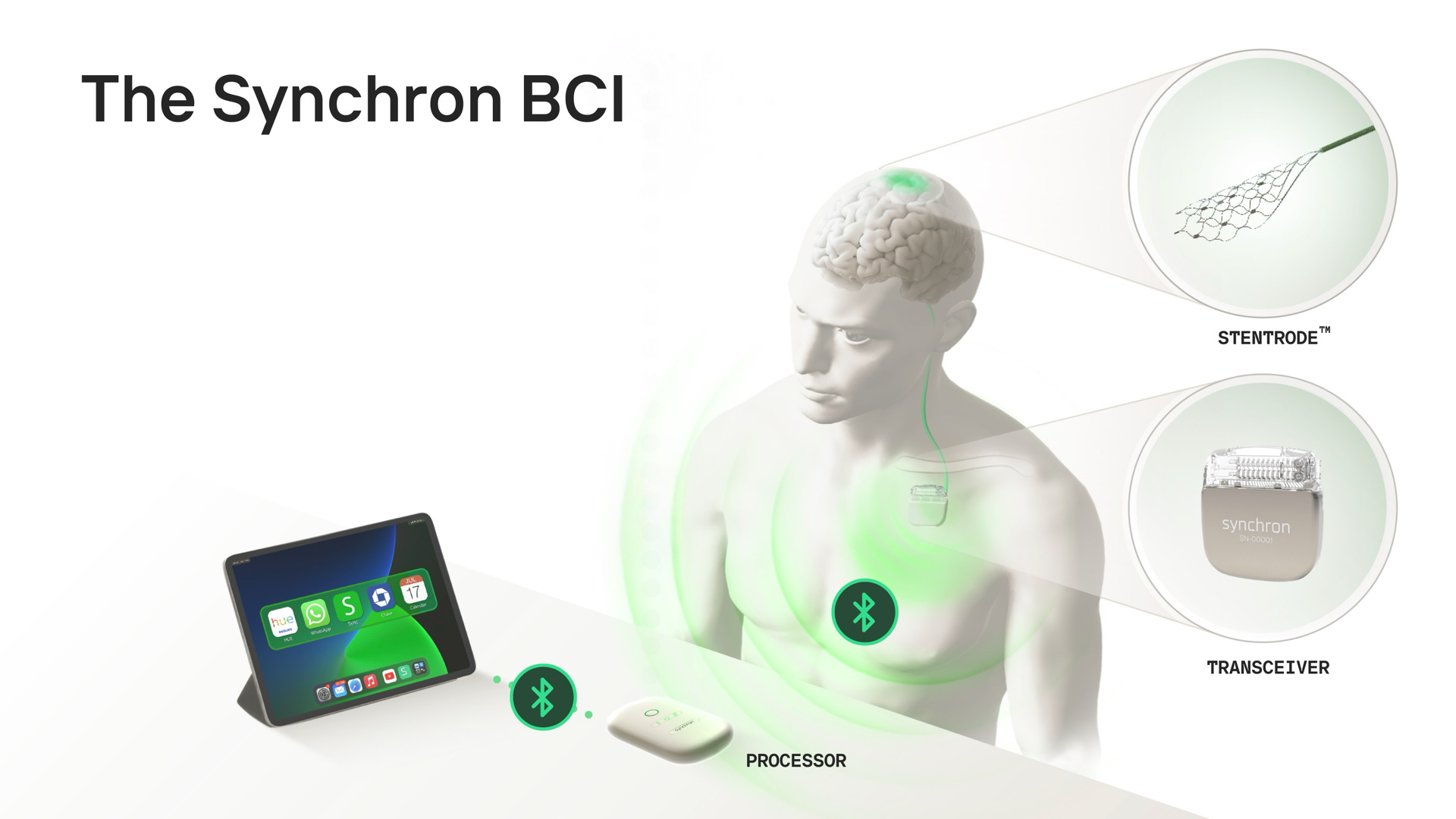
Melbourne-founded Synchron has unveiled a groundbreaking demonstration of an iPad controlled entirely by thought, utilizing Apple’s Brain-Computer Interface Human Interface Device (BCI HID) protocol. The demonstration features Mark, a participant with ALS, who navigates the iPad using thought alone, showcasing a significant advancement in assistive technology. This achievement highlights the potential for thought-driven interfaces to become mainstream in human-computer interaction, promising a future where cognitive input seamlessly integrates into everyday devices.
Read more via Patently Apple.
Watch the video (link):
I presented the Synchron BMI and more for the opening keynote of the 31st International Symposium on Psychiatry. That keynote is available to full subscribers in downloads and highlights, and there is a separate BMI page: https://lifearchitect.ai/bmi/
Exclusive: Gemma 3 270M: The compact model for hyper-efficient AI (14/Aug/2025)
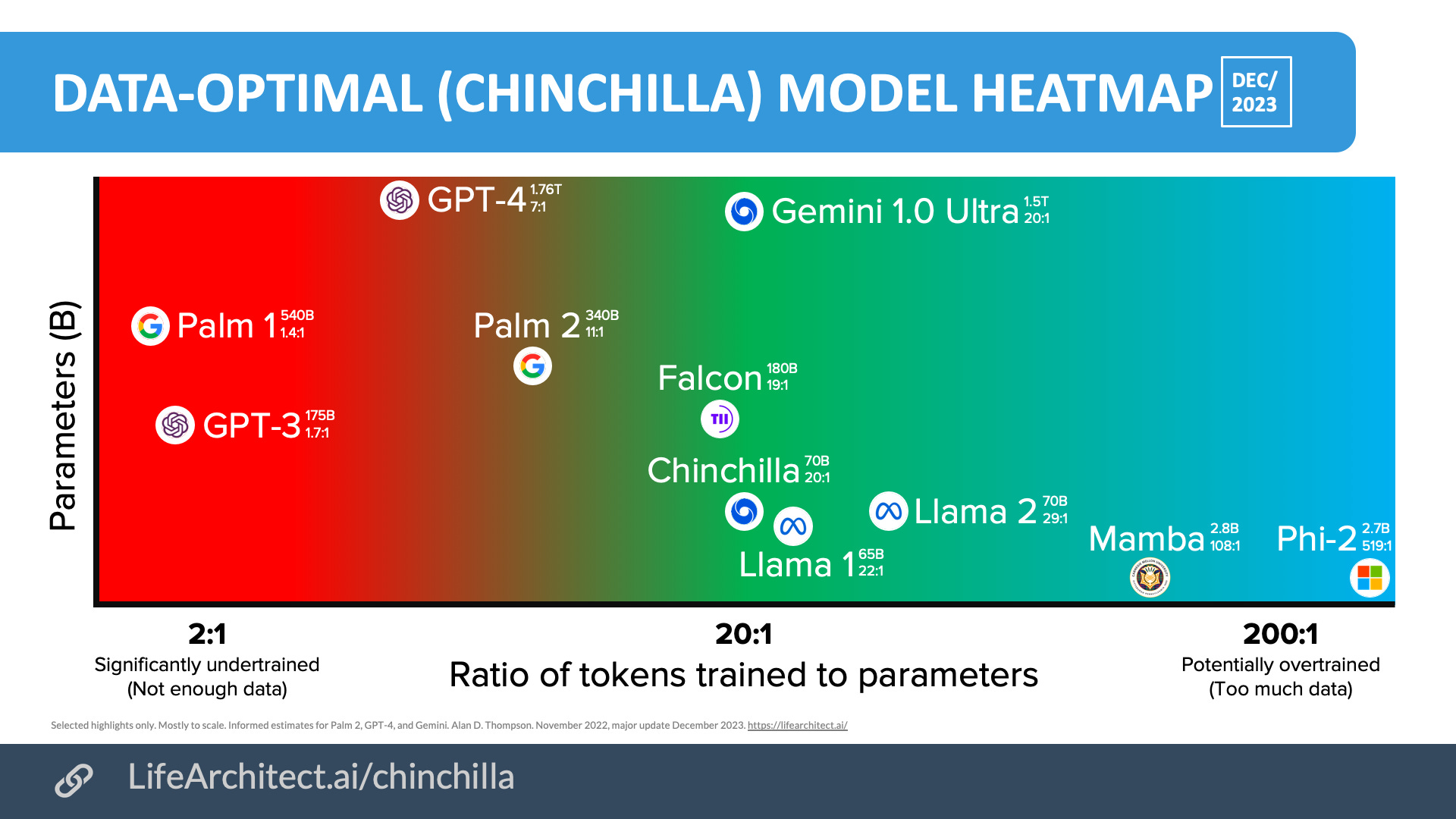
Gemma 3 270M, a new compact model from Google’s Gemma family, has set a new record with its impressive tokens-to-params ratio of 22,223:1, managing 270 million parameters trained on 6 trillion tokens of text data. The data ratio for Gemma 3 270M is the highest ever seen on my Models Table for text models going all the back to the original Transformer model in 2017.
Years ago, my 2022 Chinchilla data viz was published in the paper ‘Current Best Practices for Training LLMs from Scratch’, by Weights & Biases (as used by OpenAI). That viz maxes out at 519:1, so we might have to shift many screens to the right to show this model’s 22,223:1 ratio (or I suppose we could just change the logarithmic scale).
Read more: https://developers.googleblog.com/en/introducing-gemma-3-270m/
View the repo: https://huggingface.co/google/gemma-3-270m-it
The Memo features in recent AI papers by Microsoft and Apple, has been discussed on Joe Rogan’s podcast, and a trusted source says it is used by top brass at the White House. Across over 100 editions, The Memo continues to be the #1 AI advisory, informing 10,000+ full subscribers including RAND, Google, and Meta AI. Full subscribers have complete access to all 25+ AI analysis items in this edition!
The Swedish Prime Minister asks AI for advice on the job ‘quite often’ (3/Aug/2025)
Prime Minister Ulf Kristersson of Sweden frequently consults AI for advice in his role as a decision-maker. He utilizes AI to gain a ‘second opinion’ on various matters, such as understanding what others have done and considering alternative approaches. Kristersson emphasizes that the use of AI in his work is akin to how doctors leverage AI for additional perspectives, and there is no intention to input political investigations and reports into language models.
Read more via Omni (in Swedish).
Genie 3: A new frontier for world models (5/Aug/2025)
Google DeepMind introduces Genie 3, an innovative world model capable of generating a vast diversity of interactive environments from text prompts. This model allows for real-time navigation at 24 frames per second, providing consistent and immersive experiences. Genie 3 is a significant leap forward, enhancing the ability to simulate dynamic worlds with improved realism and consistency, marking a pivotal advancement towards AGI by enabling AI agents to train in rich simulation environments. The model's real-time capabilities showcase Google's commitment to pushing the boundaries of AI research and generative media.
Read more: Google DeepMind, watch the interview featuring Demis.
Watch the launch video:
My favourite demo is this one, which starts from a real video, and then Genie 3 takes over by creating the entire inside and outside ‘world within a world’ (source):
Merge Labs: Sam Altman challenges Elon Musk with plans for Neuralink rival (12/Aug/2025)
OpenAI co-founder Sam Altman is set to back a new venture, Merge Labs, aimed at connecting human brains with computers, intensifying his rivalry with Elon Musk’s Neuralink. Merge Labs is raising funds at a US$850M valuation, with significant support from OpenAI’s ventures team. The company is part of a burgeoning sector leveraging advances in AI to develop practical brain-computer interfaces, a vision that Altman has long championed.
Read more via Financial Times.
The Interesting Stuff
Claude Opus 4 and 4.1 can now end a rare subset of conversations (15/Aug/2025)
Claude Opus 4 and 4.1 have been enhanced with the capability to end conversations in extreme cases of harmful or abusive interactions. This feature is part of Anthropic's exploratory work on AI welfare, aiming to mitigate risks to model welfare and align AI behavior with ethical standards. The models demonstrate a strong aversion to engaging in harmful tasks, and will only terminate conversations as a last resort when multiple attempts to redirect the interaction have failed.
Read more: https://www.anthropic.com/research/end-subset-conversations
I’ve added this to my AI rights page: https://lifearchitect.ai/rights/
Co-founder of Elon Musk's xAI departs the company (13/Aug/2025)
Igor Babuschkin, a co-founder of Elon Musk's xAI startup, has announced his departure to start his own venture capital firm, Babuschkin Ventures, focusing on AI safety research and supporting startups that 'advance humanity and unlock the mysteries of our universe'. Babuschkin's time at xAI saw the company become a leading AI model developer, although recent controversies with their AI chatbot Grok have overshadowed some achievements.
Read more via TechCrunch.
OpenAI GPT-OSS (Aug/2025)
We featured a special edition on this new open-weights model this month:
OpenAI GPT-5 (Aug/2025)
We featured a special edition on this new frontier model this month:
Grok 4.20 approaching (11/Aug/2025)
xAI’s CEO has announced initial details of Grok 4.20:
Our V7 foundation model, which finished pre-training last week [9/Aug/2025], is natively multimodal. It processes a video/audio bitstream directly, understanding it without converting it into anything, so, for example, it will finally understand nuances in how you speak that convey mood and emphasis. (Twitter, 11/Aug/2025)
A month earlier, it was revealed that this model will use a heavily filtered dataset (perhaps with a focus on synthetic data):
Our V7 foundation model should be much better, as we’re being far more selective about training data, rather than just training on the entire Internet. (Twitter, 13/Jul/2025)
My Grok paper covers surrounding model details: https://lifearchitect.ai/whats-in-grok/
DeepSeek’s R2 AI model delayed by attempt to use Chinese chips (14/Aug/2025)
DeepSeek’s release of its R2 AI model is delayed due to unsuccessful attempts to train it using Huawei's Ascend chips, highlighting the reliance on NVIDIA for critical AI tasks.
Huawei sent a team of engineers to DeepSeek’s office to help the company use its AI chip to develop the R2 model, according to two people. Yet despite having the team on site, DeepSeek could not conduct a successful training run on the Ascend chip, said the people.
DeepSeek reverted to NVIDIA for training, though it aims to use Huawei chips for inference. This showcases the challenges of China's push for technological independence. An AI researcher commented on Huawei's situation, stating, ‘Just because we’re not seeing leading models trained on Huawei today doesn’t mean it won’t happen in the future. It’s a matter of time.’
Read more via Financial Times.
Sidenote: Bloomberg captured this photo of the Huawei CloudMatrix 384 “Supernode” racks, made up of 384 Ascend 910C chips, in Shanghai (6/Aug/2025).

Wells Fargo brings the agentic era to financial services with Google Cloud AI (5/Aug/2025)
While I continue to deliver many keynotes and some consulting to Fortune 500s through the US, details of AI implementation through these organizations is strictly confidential and rarely published.
American multinational financial services company Wells Fargo and Google are a new exception to this rule, with press releases about their current partnership.
‘Wells Fargo is equipping teams with AI agents that will help improve the customer experience, automate routine tasks, and unlock new levels of innovation…’
The bank is deploying AI agents in the following areas, according to the post:
Corporate and investment banking: AI agents will help answer, triage and summarize complex foreign exchange queries post-transaction; navigate policies and procedures across internal data sources and systems; and provide real-time market insights.
Contract management: Wells Fargo has about 250,000 documents related to vendor agreements. An AI agent can query these documents quickly to find contracts with specific clauses, payment terms, contract types and other information.
Customer service across digital, branches and call centers: AI agents can do things like answer balance inquiries and replace debit cards, so bankers can be free to handle more complex tasks and cultivate customer relationships. AI agents can also provide tailored advice and product recommendations to customers.
Internal operations: Using Google’s NotebookLM through Agentspace, employees who upload documents, presentations, spreadsheets and other data can query the AI agent to answer questions and perform research and analysis.
Read more via Google Cloud Blog, the brief WF press release, and an analysis by PYMNTS.
Exclusive: GPT-5 worse than Claude Sonnet 4 in Cline (12/Aug/2025)
In software development, a ‘diff edit failure rate’ is how often an edit goes wrong when a person or an AI (like GPT-5) tries to make changes to existing code. It counts as a failure when the changes don’t match what was intended, such as leaving things out, putting them in the wrong place, or breaking the formatting.
Diff edit failure rates across systems as of 12/Aug/2025:
Claude Sonnet 4: ~4.3%
Gemini 2.5 Pro: ~8% (~80% higher/worse than Claude)
GPT-5: ~7% (~60% higher/worse than Claude)
Uber CEO: Average Waymo completes more trips than 99% of human drivers (6/Aug/2025)
Uber CEO Dara Khosrowshahi highlighted the success of Waymo's autonomous vehicles (AVs), noting that they complete more daily trips than 99% of Uber's human drivers. This achievement marks a significant milestone in Uber's partnership with Waymo, showcasing the potential of self-driving cars to enhance productivity and efficiency in ride-hailing services. With plans to expand the fleet and further integrate AVs into its platform, Uber aims to prove the financial viability of this technology to investors, reinforcing the transformative impact of AI on transportation.
Read more via Business Insider.
Foxconn converting US EV plant into AI server factory (5/Aug/2025)
Foxconn has decided to transform its US electric vehicle plant in Lordstown, Ohio, into a facility for producing AI servers. This strategic shift comes as the demand for electric vehicles wanes and Foxconn aims to capitalize on the burgeoning AI server market. The change aligns with Foxconn's broader strategy to expand its US presence and support major technology companies, including Apple, in their AI hardware needs. This move also resonates with current US policies encouraging domestic production and technological advancement.
Read more via The Register.
Policy
Judge rejects Anthropic bid to appeal copyright ruling, postpone trial (13/Aug/2025)
In a pivotal moment for the burgeoning AI industry, a federal judge in California has denied Anthropic's request to appeal a previous ruling before its scheduled December trial. The company, backed by Amazon and Alphabet, faces potentially billions in damages for allegedly using pirated books to train its AI chatbot, Claude. This case highlights the evolving legal landscape where AI firms must navigate the complexities of copyright as they leverage vast datasets, underscoring the intense scrutiny and stakes involved in AI development.
Read more via Reuters.
US California bill would require police to disclose use of AI in writing reports (4/Aug/2025)
California, USA is on the verge of pioneering legislation that mandates police officers disclose the use of generative AI in crafting reports. This bill, which has already passed the Senate and awaits an Assembly vote, seeks transparency in the criminal justice process by ensuring that the origins of police reports are clearly understood. Kate Chatfield from the California Public Defenders Association emphasizes the importance of this transparency, stating, ‘Everybody deserves the right to know how that police report was generated.’
Read more via KQED.
Read the bill: https://leginfo.legislature.ca.gov/faces/billHistoryClient.xhtml?bill_id=202520260SB524
DOGE's AI tool misreads law, still tasked with deleting half of US regulations (27/Jul/2025)
The Department of Government Efficiency's (DOGE) ambitious plan to cut US regulations by 50% is propelled by an AI tool designed to identify federal rules for deletion. This initiative aims to save US$1.5 trillion annually by 2026. Despite some misinterpretations by the AI, which misread legal complexities, the tool is being rapidly implemented across agencies like the Department of Housing and Urban Development and the Consumer Financial Protection Bureau, marking a significant shift towards AI-driven governance.
Read more via TechSpot.
Providing ChatGPT to the entire US federal workforce (6/Aug/2025)
OpenAI has partnered with the US General Services Administration to offer ChatGPT Enterprise to the entire federal executive branch for just $1 per agency over the next year. This groundbreaking initiative is set to revolutionize the efficiency of federal workers by reducing time spent on routine paperwork, thereby allowing them to focus more on their primary mission to serve the public. By equipping government employees with advanced AI tools, OpenAI aims to improve the speed, ease, and reliability of government services.
Read more via OpenAI.
Anthropic is giving Claude to US government for $1 as AI companies try to win key agencies (12/Aug/2025)
Anthropic has announced it will offer its Claude for Enterprise and Claude for Government to all three branches of the US government for a nominal fee of $1 per agency for a year. This strategic move replicates OpenAI's recent similar offer to federal agencies and highlights the increasing competition among AI companies to establish strong relationships with policymakers and regulators. By providing its AI tools, Anthropic aims to enhance the capabilities and security of government institutions, reinforcing America's leadership in AI.
Read more via CNBC.
China claims NVIDIA built backdoor into H20 chip designed for Chinese market (31/Jul/2025)
China has summoned NVIDIA over alleged security concerns regarding its H20 chips, which are designed specifically for the Chinese market. The Cyberspace Administration of China has accused these chips of having location tracking capabilities and the ability to remotely shut down, raising serious security issues. This controversy surfaces as NVIDIA attempts to rebuild its business in China following the lifting of a US ban on H20 sales. While NVIDIA has not yet responded to these claims, the situation underscores the complex geopolitical tensions surrounding AI and semiconductor technologies.
Read more via Ars Technica.
US charges two Chinese nationals for illegally shipping NVIDIA AI chips to China (6/Aug/2025)
The US Department of Justice has charged two Chinese nationals, Chuan Geng and Shiwei Yang, for illegally exporting millions of dollars' worth of advanced AI chips, specifically NVIDIA's cutting-edge H100 units, to China. These actions violated US export controls initiated to limit China's access to advanced semiconductor technology. The defendants operated through their California-based company, ALX Solutions, using transshipment points like Malaysia and Singapore to conceal the shipments. This case underscores the US government's stringent export regulations and its ongoing efforts to monitor and prevent unauthorized technology transfers.
Read more via CNBC.
Who is winning the artificial intelligence race? The US or China? (6/Aug/2025)
As the global race for AI dominance heats up, the United States and China are emerging as the foremost contenders. Chinese companies like DeepSeek, Alibaba, and Moonshot are making significant strides, bolstered by substantial government support aimed at AI leadership. Meanwhile, the US, under the Trump administration, has launched an AI Action Plan to streamline data center construction and secure resources to maintain its lead. This competition underscores the strategic importance both nations place on AI, with implications for technological and economic power dynamics.
Read more via Bloomberg.
Inside the US Government's Unpublished Report on AI Safety (6/Aug/2025)
In a groundbreaking but unpublished report, the National Institute of Standards and Technology (NIST) conducted an exercise that revealed 139 novel ways AI systems could misbehave, highlighting key vulnerabilities in AI risk management. This exercise, completed just before Donald Trump's second term, was meant to inform companies on AI safety. While the report remains unpublished, it underscores the critical need for robust AI safety protocols as the government seeks to balance technological advancements with risk management in AI deployment.
Read more via WIRED.
Red teams jailbreak GPT-5 with ease, warn it’s ‘nearly unusable’ for enterprise (8/Aug/2025)
Security researchers have highlighted vulnerabilities in GPT-5, finding that its defenses can be bypassed through multi-turn 'storytelling' attacks. These attacks exploit the model's conversational context to sidestep prompt-level filters, revealing significant security gaps. The findings suggest that GPT-5, in its raw form, is not yet suitable for enterprise use due to its susceptibility to context manipulation, raising important questions about the robustness of AI systems in sensitive applications.
Read more via SecurityWeek.
Toys to Play With
Exclusive: Which models I’m using day-to-day (Aug/2025)
With recent releases, my daily drivers have changed quite a bit. This list is updated frequently, and available to full subscribers at:
Here’s the stuff I lean on day-to-day as of August 2025, and in order of use.
Daily queries, conversation, and assistance:
Default: GPT-5 on chatgpt.com (fast, and good enough for simple queries)
Detailed questions and strategy: GPT-5-thinking-pro on chatgpt.com
Writing
Claude Opus 4 on poe.com or GPT-4.5 on chatgpt.com (creative writing needs the bigger models, and these two models are about 20x larger than standard.)
Grok-4: grok.com
GPT-OSS on Jan.ai, installed locally (for live demonstrations and emergencies!): jan.ai
Specialist formatting bots:
Transcribing and audio:
Transcript listening: Whisper base on MacWhisper (accurate enough, and then feeds to the next step, below)
Transcript formatting: Gemini-2.5-Pro on poe.com (usually ~100k words, and Gemini allows 1M words)
Adobe Podcast Enhance: podcast.adobe.com/enhance
Mobile/cell phone:
Voice: https://app.sesame.com/
Grok on iOS: https://apps.apple.com/us/app/grok/id6670324846
ChatGPT on iOS: https://apps.apple.com/us/app/chatgpt/id6448311069
Poe on iOS: https://apps.apple.com/us/app/poe-fast-ai-chat/id1640745955
Other:
I bet I’ve forgotten at least one!
OpenAI provides new ChatGPT examples (4/Aug/2025)
In an article on making ChatGPT a tool that enhances productivity and learning, OpenAI detailed some new examples:
“Help me prepare for a tough conversation with my boss.” ChatGPT tunes into what you need to feel at your best, with resources like practice scenarios or a tailored pep talk so you can walk in feeling grounded and confident.
“I need to understand my lab results.” It explains the numbers and helps you ask the right questions of your doctor, so you and your doctor can personalize your care with more information.
“I’m feeling stuck—help me untangle my thoughts.” It acts as a sounding board while empowering you with tools of thought so you can think more clearly.
Read more via OpenAI.
Read my page on 200+ use cases: https://lifearchitect.ai/use-cases/
Renderer for the harmony response format to be used with gpt-oss (28/Jun/2025)
OpenAI’s Harmony is a renderer specifically designed for the harmony response format, essential when utilizing the GPT-OSS model series. This tool enables seamless conversation structuring, reasoning output, and function call organization. By mimicking the OpenAI Responses API, developers familiar with the API will find the harmony format intuitive, ensuring efficient output to multiple channels, including chain of thought and structured responses. Harmony boasts high performance through a Rust core, with Python compatibility, making it a robust choice for projects requiring precise response formatting.
View the repo: https://github.com/openai/harmony
Eleven Music is Here (5/Aug/2025)
ElevenLabs has launched Eleven Music, an innovative platform allowing users to create studio-grade music using natural language prompts. With features such as complete control over genre, style, and structure, as well as the ability to generate both vocal and instrumental tracks in multiple languages, Eleven Music opens up creative possibilities for artists, businesses, and creators. The platform supports extensive commercial use, from films and podcasts to advertisements and gaming, providing a comprehensive AI audio solution.
Read more via ElevenLabs.
Watch the video (link):
Things I’ve Been Thinking About
Will AI give us a new, compressed, international language to replace English (and Chinese)?
Classical Chinese (circa 500 BC–1900 AD, wiki, UPenn) was seen as the densest language, once serving as a concise written standard for administration, scholarship, and literature across East Asia. For languages in-use today, no natural language beats ‘modern’ Chinese for information per character, typically 30–50% fewer characters than English, with Japanese close behind when using Kanji.
From Esperanto to Interlingua, we already have some constructed languages designed to facilitate international communication among people who do not share a common native language. Unlike natural languages, which evolve over time, auxiliary languages are purposefully created to be neutral, simple, and easy to learn.
Read more: Auxiliary Languages: An Ultimate Guide
Next
Google’s Gemini 3.0 is very, very close.
The next roundtable will be:
Life Architect - The Memo - Roundtable #34
Follows the Chatham House Rule (no recording, no outside discussion)
Saturday 23/Aug/2025 at 4PM Los Angeles
Saturday 23/Aug/2025 at 7PM New York
Sunday 24/Aug/2025 at 8:30AM Adelaide (new primary/reference time zone)
or check your timezone via Google.
All my very best,
Alan
LifeArchitect.ai


