The Memo - 24/May/2026
Figure 04 design lock, Neuralink + art, ASI updates, and much more!

To:      US Govt, major govts, Microsoft, Apple, NVIDIA, Alphabet, Amazon, Meta, Tesla, Citi, Tencent, IBM, & 10,000+ more recipients…
From:    Dr Alan D. Thompson <LifeArchitect.ai>
Sent:    24/May/2026
Subject: The Memo - AI that matters, as it happens, in plain English
AGI:     97%
ASI:     0/50 ➜ 2/50
Dawid Naude, CEO of Pathfindr (Jun/2025):
'If you wanted to be in the top 1% of understanding AI globally - you only need to read one thing each week. With AI news and content - you have a choice, be informed, or, be distracted. But if you wanted to read only 1 newsletter that is rich, thought out, distilled incredible insight - and started 5 years ago - I cannot recommend ‘The Memo’ by Alan D. Thompson more highly. It’ll take you about 30 minutes to get through each week, and honestly - if debating whether you should get the paid version or free version - reflect on your spending choices.’
Happy upcoming sixth birthday to GPT-3 (28/May/2020), the model that started it all, powered the popular Leta AI series, and two and a half years later became ChatGPT.
Contents
The BIG Stuff (Figure 04 design lock, Neuralink + art, ASI updates…)
The Interesting Stuff (Interaction models, Anthropic beats OpenAI, Unitree GD01…)
Policy (DC 6% electricity, OpenAI & Malta, Musk loses, Mythos updates, Microsoft…)
Toys to Play With (AI radio, 20T-token dataset, GPT and finance, the latest in AI film…)
Things I’ve Been Thinking About (Air conditioning…)
Next (The genie and the frog, Roundtable…)
The BIG Stuff
Figure 04 reaches full design lock (13/May/2026)
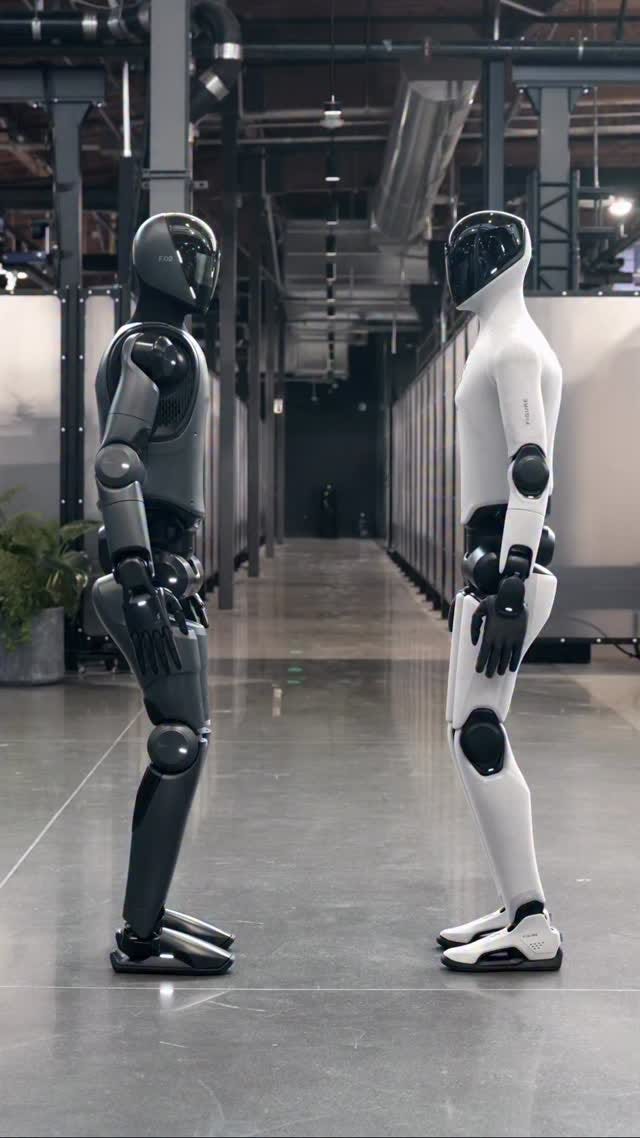
Figure CEO Brett Adcock has confirmed that the company’s fourth-generation humanoid has achieved full design lock, with parts already shipping for assembly. Adcock calls Figure 04 the industry’s ‘iPhone 1 moment,’ describing it as ‘by far the biggest leap we’ve ever made between robot generations,’ moving beyond the ‘flip phone’ era of Figures 01 through 03. The US$39B startup is targeting mass manufacturability through die-casting and injection molding, integrating seventh-generation hands with human-level dexterity.
Read more via Humanoids Daily and source Tweet.
Sidenote: The most recent The Memo roundtable covered topics from CETI tonal languages to world models. We also commented on the extended F.03 livestream, where we watched it hit 100,000 packages (see the 200 hours champagne moment).
ASI updates (May/2026)
The ASI checklist sees frequent updates, about once per week. For May 2026, these early indicators included:
#4 & #5 maths (first full achievements), featured in our special edition.
#6, #7, & #38 Environmental remediation: Kemira and CuspAI used generative AI to design novel metal-organic frameworks (MOFs) for removing PFAS ‘forever chemicals’ from drinking water. The platform searched ~300 trillion possible structures, delivered 5,000+ novel material designs across three priority PFAS molecules, and narrowed to ~20 candidates now advancing to development. Advisors include Geoffrey Hinton and Yann LeCun. Announce.
#2 Recursive code self-optimization: Mistral cofounder and CEO Arthur Mensch tells the French Parliament that ‘today, engineers at Mistral no longer write lines of code,’ relying instead on AI agents to produce and integrate software. Hearing, clip, English article.
#25 First country with UBI-equivalent: South Korea’s presidential chief of staff for policy, Kim Yong-beom, proposed a ‘national dividend’ (or ‘citizen dividend’) that would return excess tax revenue from the AI boom to all citizens. Invoking Norway’s sovereign wealth fund as a template, Kim wrote: ‘There is a rare historical possibility in front of Korea. It is the possibility of becoming the first nation not only to provide AI infrastructure but also to redistribute the excess profits of the AI era back into human lives.’ Korea Herald, Korea Times, Bloomberg.
#22 AI-run companies: Andon Labs deployed an AI agent named Mona [Gemini 3.1 Pro] to autonomously run a café in Stockholm, hiring and managing human baristas via Slack. Mona analysed the lease, navigated Swedish bureaucracy (food registration, alcohol licensing, outdoor seating permits), set up supplier accounts, posted job ads, reviewed resumes, and conducted phone interviews. Announce, model.
#28 First region primarily governed by AI: Shenzhen Intermediate People’s Court reports an AI system helped judges handle 50% more cases in 2025. The domain-specific large language model covers 85 judicial procedures including case filing, review, court hearings, and document preparation. The pilot system has been rolled out across 23 courts in 11 Chinese provinces. Article.
#2 Recursive code self-optimization: Codex was the primary author of a major OpenAI model release. OpenAI researcher Dr Boyuan Chen reports that ‘GPT Image 2 is 99% coded by Codex… In the last 6 months, Codex has been zero-shotting every single prompt I tried… We are integrating it back into the Codex ecosystem for more agentic capabilities.’ Announce.
Read more: https://lifearchitect.ai/asi/
Neuralink’s first female participant uses BCI to create art with her mind (16/May/2026)
Audrey, paralyzed from the neck down after a car accident over 20 years ago, is now the first female participant in Neuralink’s clinical trials and is using her brain-computer interface to draw and paint again, controlling digital tools purely through thought. This represents a striking real-world demonstration of the BCI moving beyond cursor control and communication into creative expression.
Watch the video (link):
The Memo features in recent AI papers by Microsoft and Apple, has been discussed on Joe Rogan’s podcast, and a trusted source says it is used by top brass at the White House. Across over 100 editions, The Memo continues to be the #1 AI advisory, informing 10,000+ full subscribers including RAND, Google, and Meta AI. Full subscribers have complete access to all AI analysis items in this edition!
The Interesting Stuff
Interaction models: a scalable approach to human-AI collaboration (11/May/2026)
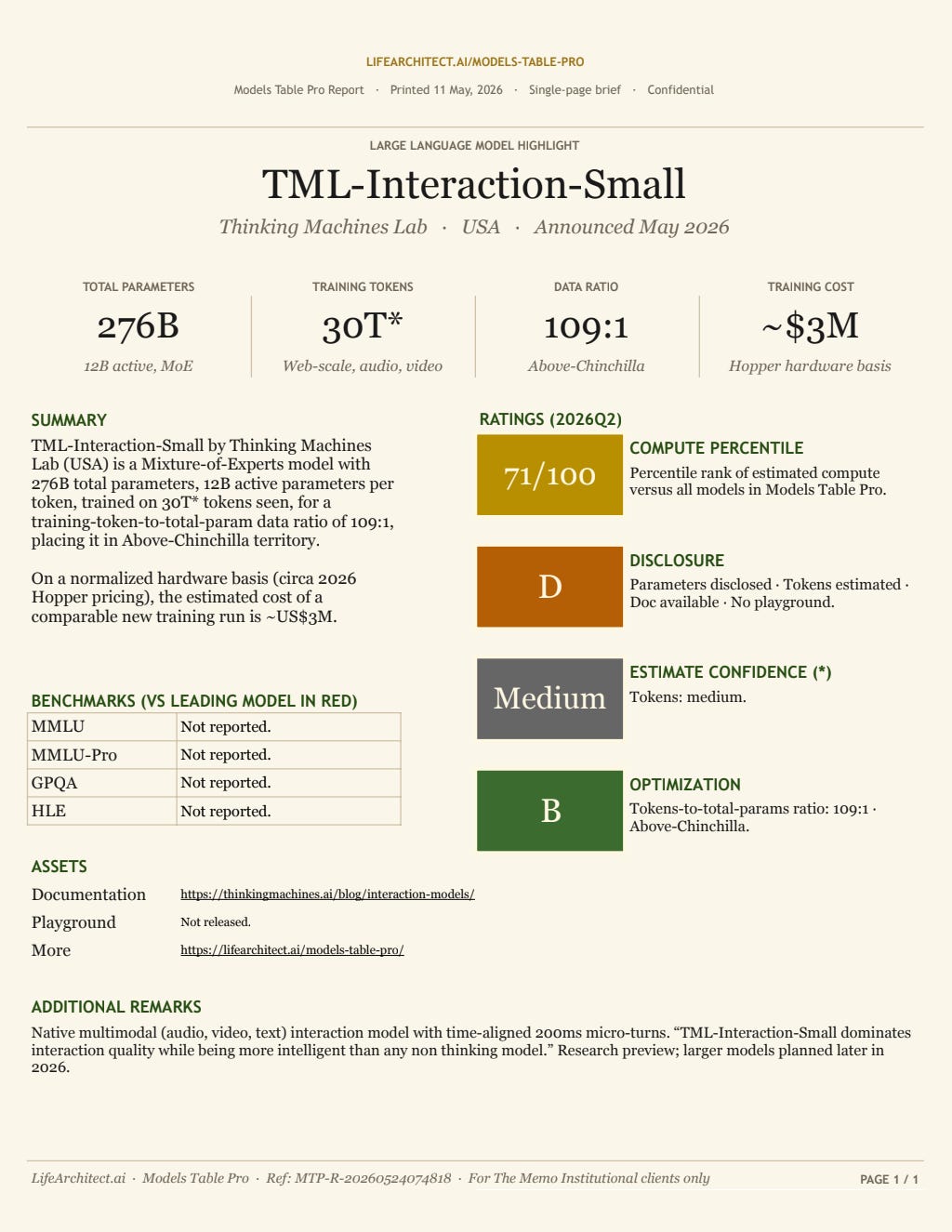
Thinking Machines Lab (a company comprising several ex-OpenAI and ex-Anthropic rockstars including Alec Radford, lead author of GPT-1, GPT-2, and GPT-3, and John Schulman, ‘architect’ of ChatGPT) has introduced ‘interaction models’. TML-Interaction is trained from scratch to handle real-time, bidirectional collaboration across audio, video, and text via a 200ms micro-turn architecture, rather than bolting interactivity onto turn-based systems with external harnesses. Their model dominates interaction quality benchmarks while outperforming all non-thinking models on intelligence, and is the first to meaningfully perform time-aware and visually proactive tasks that no existing commercial system can handle. ‘For interactivity to scale with intelligence, it must be part of the model itself.’
This model needs to be seen and heard to be believed. The first video (below) made me laugh.
Watch ‘Simultaneous speech’ (link):
Watch ‘Coach in your ear’ (link):
Sidenote: Institutional subscribers can now access Models Table Pro including emailed reports on highlight models, plus one-click report generation for any model in the table. The TML-Interaction-Small single-page brief is shown below.