The Memo - 14/Nov/2025
ERNIE 5.0 2.4T, Xpeng IRON update, OpenAI 1M companies, and much more!
To: US Govt, major govts, Microsoft, Apple, NVIDIA, Alphabet, Amazon, Meta, Tesla, Citi, Tencent, IBM, & 10,000+ more recipients…
From: Dr Alan D. Thompson <LifeArchitect.ai>
Sent: 14/Nov/2025
Subject: The Memo - AI that matters, as it happens, in plain English
AGI: 95%
ASI: 0/50 (no expected movement until post-AGI)There’s a soundtrack to this edition. ‘Walk my walk’ by Breaking Rust hit #1 on the Billboard Country Digital Song Sales chart, and is AI-generated (NPR, 10/Nov/2025).
Listen: https://youtu.be/g_K0tOwUJ1k
Contents
The BIG Stuff (Xpeng IRON update, OpenAI 1M companies, pre-ASI findings…)
The Interesting Stuff (ERNIE 5.0 2.4T, TPUs GA, GPT-5.1, Tesla 100GW, Airbnb…)
Policy (China v US, OpenAI, copyright, Ilya Sutskever speaks, Greg Brockman…)
Toys to Play With (New Udio replacement, screen watcher, image gen comparison…)
Things I’ve Been Thinking About (Post-ASI + paper on entertainment/meaning…)
Next (Roundtable…)
The BIG Stuff
Xpeng IRON update (5/Nov/2025)
Xpeng’s AI Day 2025, themed ‘Emergence’, showcased a transformative leap in physical AI with the unveiling of the next-gen IRON (plus the Xpeng VLA 2.0 model, Robotaxi, and innovative flying systems). He Xiaopeng, Chairman and CEO, declared Xpeng’s new identity as a ‘global embodied intelligence company’.
The XPENG Next-Gen IRON is equipped with 3 Turing AI chips, with an effective computing power of 3000 TOPS, and at the same time, it is the first to be equipped with XPENG’s first-generation physical world large model. By constructing a high-order combination of capabilities of the “VLT + VLA + VLM”, it realizes the three high-order intelligences of “conversation, walking, and interaction”.
…“VLT large model” is a brand-new large model specifically developed for robots , regarded as the core engine for robots’ autonomous actions, enabling them to achieve in-depth thinking and autonomous decision-making.
Read more via Xpeng.
Here’s a two-minute clip of the humanoid robot walking on stage (link):
Sidenote: The Memo editor, Jess, asks ‘Why did they make the Xpeng robot sexy? 🫠‘
Watch an alternative video by EuroNews.
OpenAI secures 1 million businesses (5/Nov/2025)
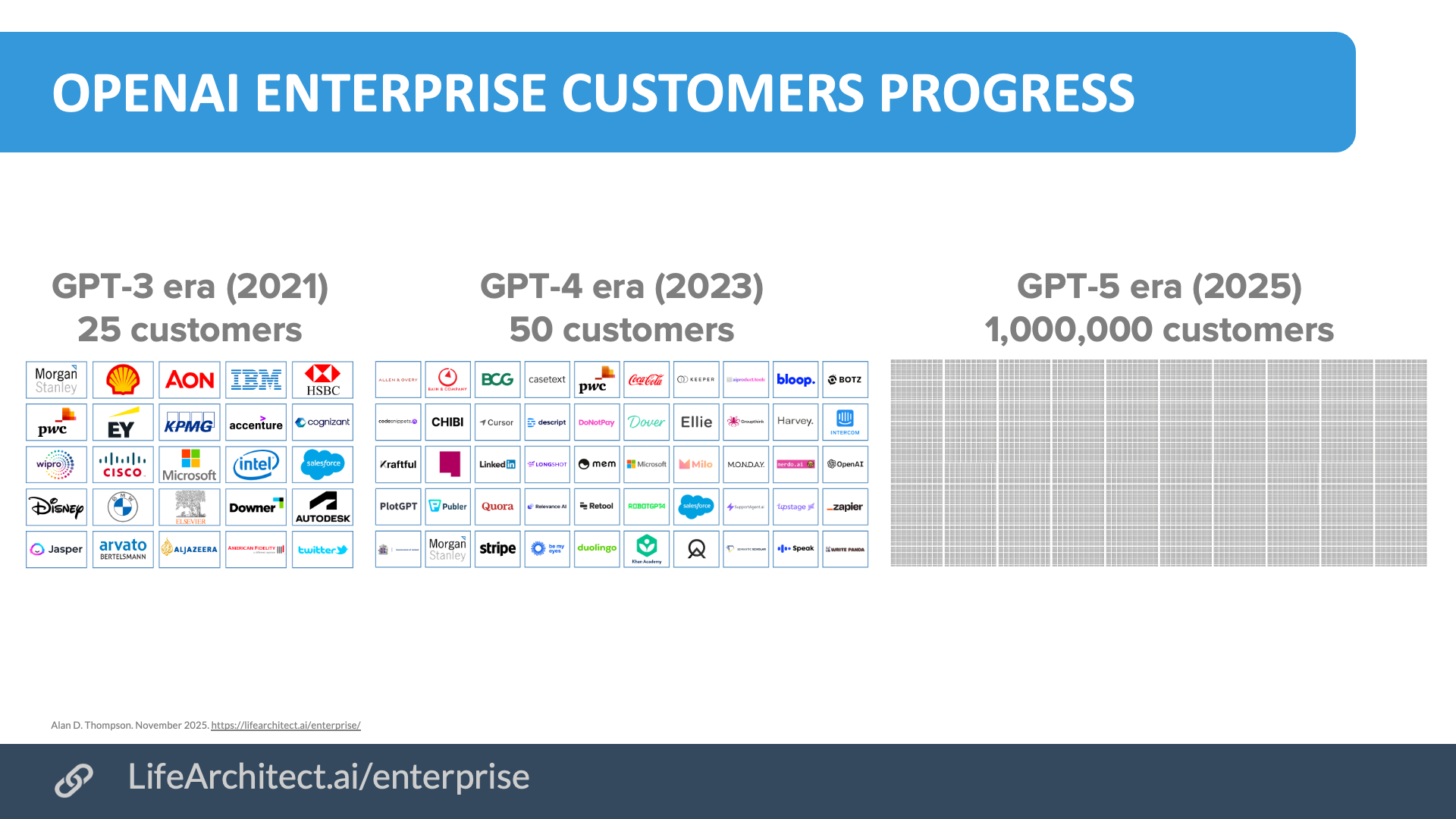
OpenAI has surpassed 1 million business customers, making it the fastest-growing business platform ever. Companies include Amgen, Commonwealth Bank (hence the opening of the new Sydney office here in Australia!), LG, Singapore Airlines, eBay, T-Mobile, Booking.com, Lowe’s, Target, and Cisco. With over 800 million weekly users familiar with ChatGPT, the adoption rate within businesses has skyrocketed, facilitating rapid pilot completions and reducing rollout friction.
Read more via OpenAI.
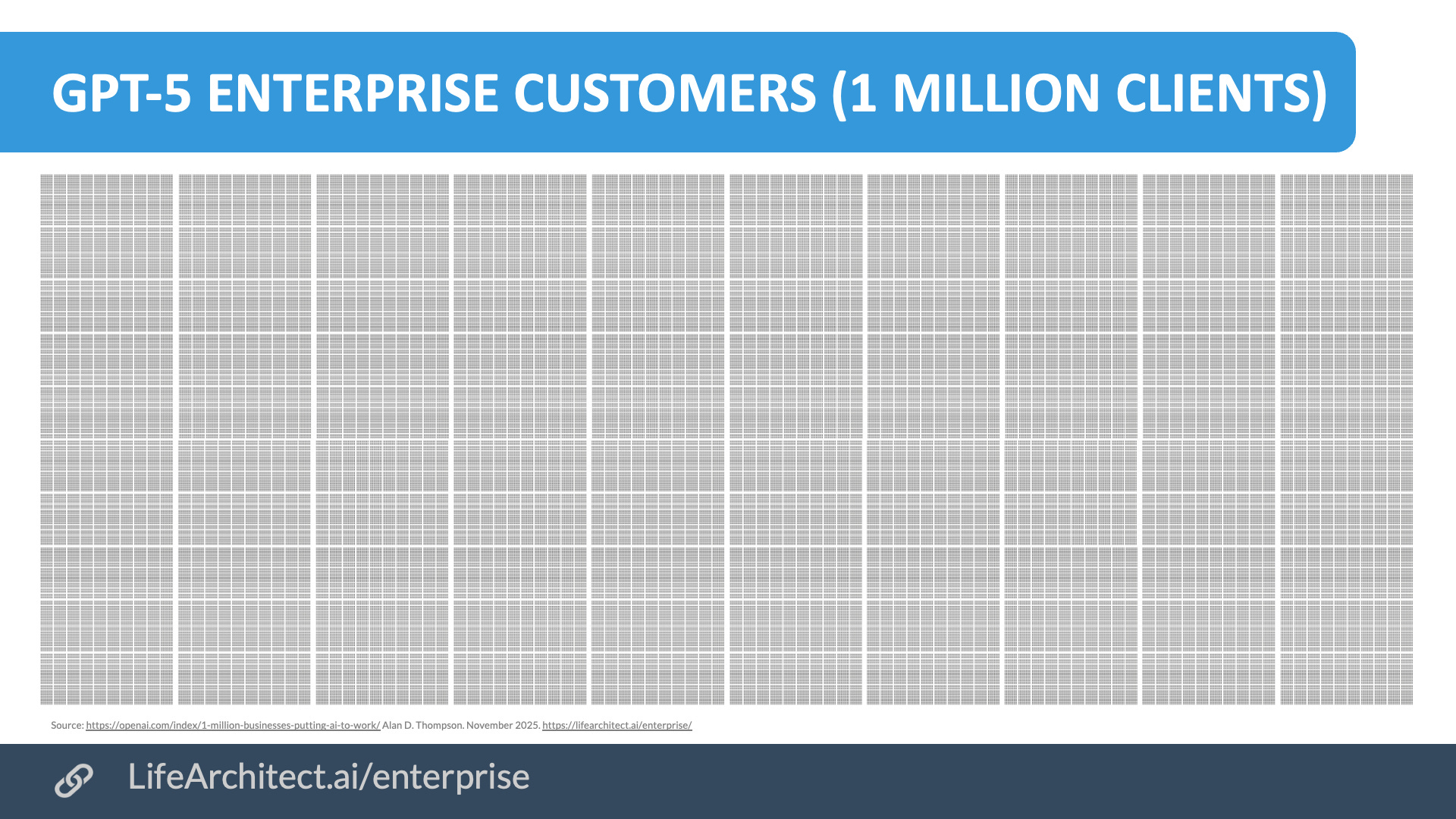
I’ve been documenting this since 2020, easily seen in the combined viz above, but here’s a zoom of all 1,000,000 dots, each representing a different business logo:
Exclusive: More human experts are coming to terms with pre-ASI model capabilities (Nov/2025)
Professor Mark Humphries was shocked by his recent experience of a new Gemini model, probably Gemini 3, being applied to the field of transcribing handwritten historical documents. What Gemini did was complex (and worth reading), but the gist is that while transcribing a 1758 merchant’s ledger, Gemini encountered the ambiguous text ‘To 1 loff Sugar 145’. The AI correctly inferred the text meant ‘14 lb 5 oz’ by working backwards from the total cost (0/19/1) and unit price (1/4) to calculate the weight (229 pence / 16 pence = 14.3125 lb). The author calls this ‘genuine, human-like, expert level reasoning’.
…no one asked Gemini to do this. It took the initiative to investigate and clarify the meaning of the ambiguous number all on its own. And it was correct.
…there is something in this new machine that is markedly different. From my admittedly limited tests, the new Gemini model handles this type of data much better than any previous model or student I’ve encountered…
…we need to extrapolate from this small example to think more broadly: if this holds [then] the models are about to make similar leaps in any field where visual precision and skilled reasoning must work together [as] required. As is so often the case with AI, that is exciting and frightening all at once. Even a few months ago, I thought this level of capability was still years away.
What this new Gemini model seems to show is that near-perfect handwriting recognition is better achieved through the generalist approach of LLMs. Moreover, the model’s ability to make a correct, contextually grounded inference that requires several layers of symbolic reasoning suggests that something new may be happening inside these systems—an emergent form of abstract reasoning that arises not from explicit programming but from scale and complexity itself…
...[this new Gemini model] is demonstrating an understanding of the economic and cultural systems in which those records were produced…and then using that knowledge to re-interpret the past in intelligible ways.
Read it: https://generativehistory.substack.com/p/has-google-quietly-solved-two-of
Although the scale of these models has increased dramatically, the technology behind them has not changed substantially since 2020, with GPT-3. Beginning with that model’s capabilities, it was clear what was happening, and I issued a raft of warnings internationally:
19/Sep/2021: ‘AI is outperforming humans in both IQ and creativity in 2021’ https://lifearchitect.ai/outperforming-humans/
20/Jul/2021: ‘AI fire alarm’ https://lifearchitect.ai/fire-alarm/
Jan/2022: ‘AI report submission to UN’ https://lifearchitect.ai/un/
25/Oct/2023: ‘Leaders guilty of negligence’ https://lifearchitect.ai/leaders-guilty-of-negligence/
2021–present: The Memo editions including the one that you’re reading right now!
What’s particularly fascinating is how hidden some of these experts’ discoveries are. We have professors and subject matter experts and peak performers in niche fields around the world privately testing frontier models against their specialty. (I picture them sitting in their lab with the same excited or shocked or horrified expression on their face that I had four years ago with the Leta experiments.)
Each time, they’re finding that the model outperforms human experts, with private or public statements like Mark’s: ‘What this new [frontier] model seems to show is that [my field’s specialist data and analyses] is better achieved through the generalist approach of LLMs.’
We saw it in a big way last year (Jun/2024) when Adam Unikowsky, who was a former law clerk to Justice Antonin Scalia, and won eight Supreme Court cases as lead counsel, said:
Claude is fully capable of acting as a Supreme Court Justice right now... I frequently was more persuaded by Claude’s analysis than the Supreme Court’s… Claude works at least 5,000 times faster than humans do, while producing work of similar or better quality…
We’re going to keep seeing this happen.
And they’ll keep acting surprised.
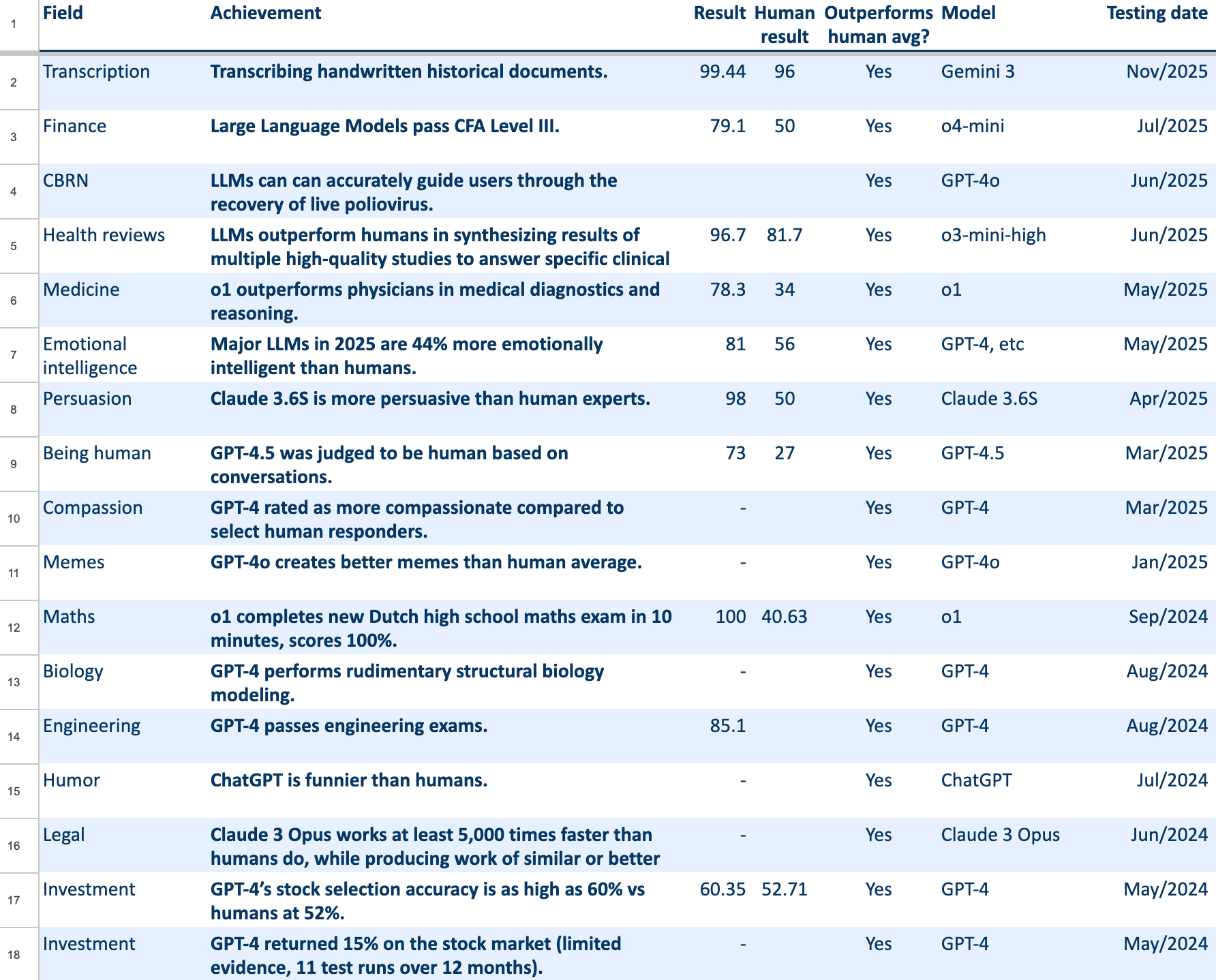
I continue to track superintelligence indicators at: https://lifearchitect.ai/asi/
On that page, I’ve been tracking major pre-ASI capabilities for a while, screenshot below: https://lifearchitect.ai/asi/#capabilities
The Interesting Stuff
Google Ironwood TPUs: General availability (6/Nov/2025)
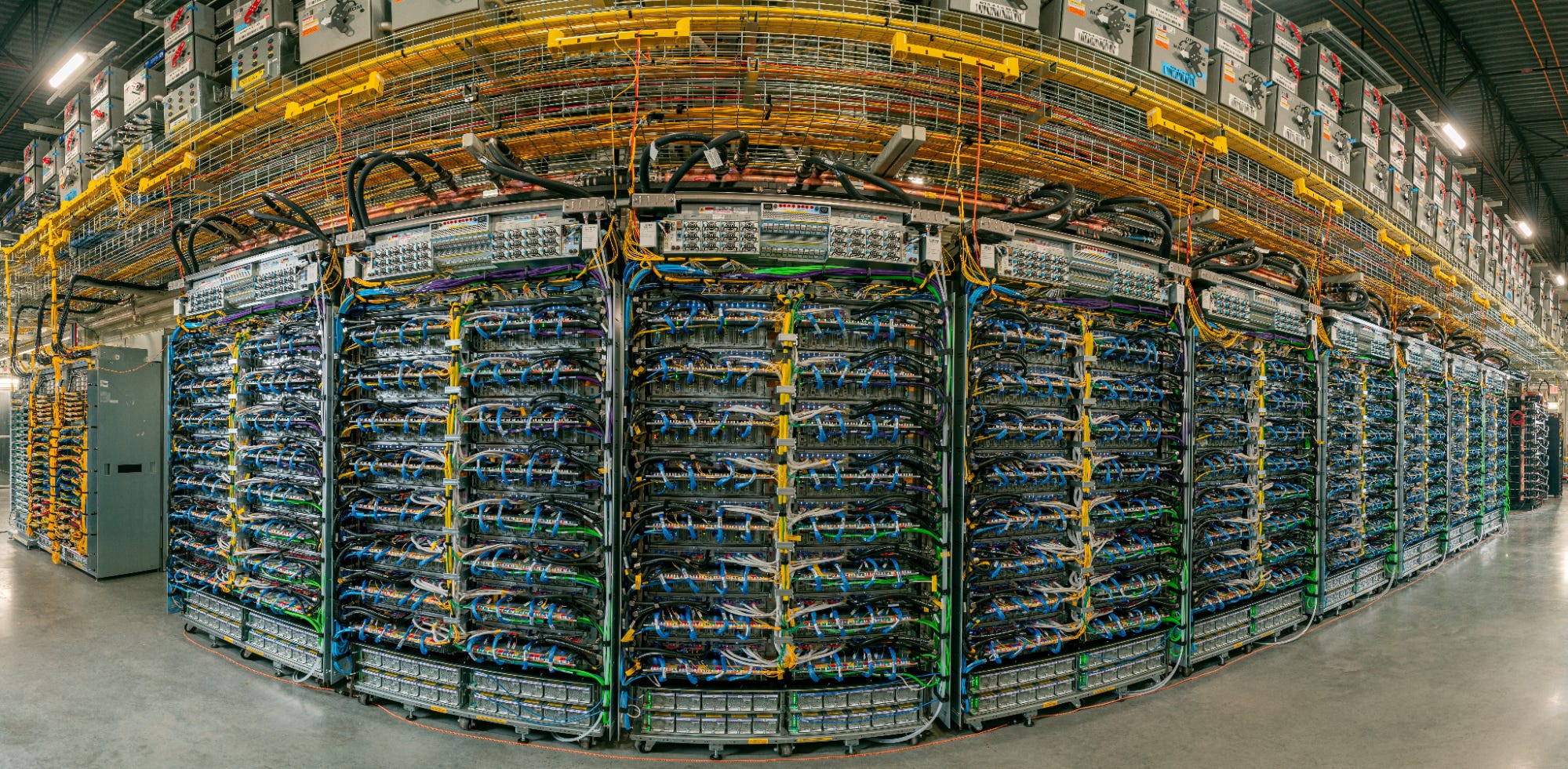
Near the beginning of my keynotes, I still feature video of a Microsoft datacentre to show the birthplace and home of GPT. Google’s latest photo looks far more impressive though: racks with over 9,000 TPUs serving Gemini, Claude, and more.
TPUs have been Google’s trade secret and strategic advantage since 2015. A decade later, Google Cloud has announced the ‘general availability’ of the latest Ironwood TPUs, marking a significant advancement in AI infrastructure.
Today’s frontier models, including Google’s Gemini, Veo, Imagen, and Anthropic’s Claude train and serve on Tensor Processing Units (TPUs)…
10× peak performance improvement over TPU v5p and more than 4× better performance per chip for both training and inference workloads compared to TPU v6e (Trillium)…
9,216 chips in a superpod linked with breakthrough Inter-Chip Interconnect (ICI) networking at 9.6Tb/s. This massive connectivity allows thousands of chips to quickly communicate with each other and access a staggering 1.77 Petabytes of shared High Bandwidth Memory (HBM)…
Read more via Google Cloud Blog.
The Memo features in recent AI papers by Microsoft and Apple, has been discussed on Joe Rogan’s podcast, and a trusted source says it is used by top brass at the White House. Across over 100 editions, The Memo continues to be the #1 AI advisory, informing 10,000+ full subscribers including RAND, Google, and Meta AI. Full subscribers have complete access to all 25+ AI analysis items in this edition!
Baidu ERNIE 5.0 (13/Nov/2025)
We’ve been waiting for this model for a while.
Total parameter count is 2.4T MoE; and I’ve estimated the dataset to hit 100T tokens trained.
The benchmarks were obfuscated (13/Nov/2025), and my testing showed unimpressive results using the standard ALPrompt.
Reuters reports (13/Nov/2025):
In benchmarks presented by Baidu on stage, Ernie 5.0 competed with rivals like DeepSeek, Alphabet Inc.’s Google Gemini and OpenAI’s GPT-5 in tests for language, audio and visual understanding. While Baidu’s AI rarely had the highest score, the company sought to demonstrate it was keeping up with the leaders.
Baidu had a headstart in China’s AI race and looked at one point like the country’s most formidable rival to OpenAI, but it soon lost leadership to rivals including ByteDance Ltd. and Alibaba Group Holding Ltd. The two, respectively, lead in AI-native applications and open-source models, while Baidu is struggling to catch up on both fronts.
Read the analysis by China Daily.
See it on the Models Table: https://lifearchitect.ai/models-table/
Try it (free, login, switch to Ernie 5.0 in picker): https://ernie.baidu.com/
GPT-5.1: A smarter, more conversational ChatGPT (12/Nov/2025)
OpenAI has launched GPT-5.1, enhancing the GPT-5 series with models that are smarter and more conversational and customizable. The rollout begins with paid users and introduces GPT-5.1 Instant, which is more engaging and responsive, and GPT-5.1 Thinking, which is adept at advanced reasoning tasks.
GPQA (no tools) increased from GPT-5=85.7 to GPT-5.1=88.1.
Announce: https://openai.com/index/gpt-5-1/
See GPT-5.1 on the Models Table: https://lifearchitect.ai/models-table/
Try it (available to ChatGPT Pro subscribers for now): https://chatgpt.com/
Google: Introducing Nested Learning: A new ML paradigm for continual learning (7/Nov/2025)
The AGI countdown requires adaptive or continuous learning, and I reckon all five major labs already have solutions to this brewing…
Google Research has unveiled Nested Learning, a groundbreaking approach to machine learning designed to tackle the issue of ‘catastrophic forgetting’, where models lose proficiency in old tasks when learning new ones. By treating models as a series of interconnected, nested optimization problems, Nested Learning harmonizes the model’s architecture and optimization algorithm, creating a unified learning system. This paradigm was validated with the ‘Hope’ architecture, which demonstrated superior performance in language modeling and long-context memory management, showcasing its potential to mimic the continual learning abilities of the human brain.
Read more via Google Research.
See Hope on the Models Table: https://lifearchitect.ai/models-table/
Chevron picks Texas for first AI data center power project (12/Nov/2025)
Big Oil is looking to cash in on the enormous demand for energy that will be needed to power data centers, which are being located further away from major population centers and closer to sources of fuel.
Chevron Corp. has selected West Texas as the site for its inaugural natural gas-fired power project aimed at data centers, signaling a strategic shift to leverage the AI boom. In collaboration with Engine No. 1, Chevron plans to utilize its significant natural gas output from the Permian Basin to power a facility expected to generate up to 5,000 megawatts. '
Read more via Yahoo Finance.
At some [US] doctors’ offices, AI is listening in the exam room (10/Nov/2025)
I’m not sure why it has taken this long, but as of November 2025, we are finally seeing broader use of GPT technology from 2020 in US healthcare…
Doctors at the University of Pennsylvania (Penn) and Thomas Jefferson University Hospital in Philadelphia, USA, are using AI scribes and ambient listening to automatically document patient visits. This innovation allows doctors to focus more on patient interactions while AI handles note-taking, thereby improving the overall quality of care and reducing administrative burdens. Jefferson Health aims to reclaim 10 million clinical hours by 2028 through these AI tools, while Penn Medicine has already observed a 20% reduction in time spent on electronic health records during appointments.
Read more via The Philadelphia Inquirer.
Sidenote: Here in Australia, we’re implementing Heidi AI across some medical settings:
Read more: https://www.heidihealth.com/
Watch the video (Feb/2025):
DeepMind PhysWorld: Robot learning from a physical world model (10/Nov/2025)
PhysWorld is a groundbreaking project that unifies video generation with real-to-sim world modeling to achieve zero-shot robotic manipulation. This innovative approach leverages a single video to enable robots to learn and perform complex tasks without prior real-world data on the specific task.
The approach needs no real-robot data for the specific task, only the single photo and the sentence, so it can be applied to new objects and new instructions immediately…
When the rehearsed plan is moved to the real world the robot succeeds about 82% of the time across ten different kitchen and office chores, roughly 15 percentage points better than previous zero-shot methods. Failures from bad grasps fall from 18% to 3% and tracking errors drop to zero, showing that the quick physics rehearsal removes most of the mistakes that come from blindly imitating video pixels.
See the videos: https://pointscoder.github.io/PhysWorld_Web/
Read the paper: https://arxiv.org/pdf/2511.07416
See the project page: https://hesic73.github.io/OpenReal2Sim_demo/
Exclusive: Coca-Cola AI ad (3/Nov/2025)
Coca-Cola’s 2025 holiday campaign again used AI-powered storytelling and AI-driven adaptations of classic Coca-Cola holiday ads. “Leveraging advanced GenAI tools, we controlled every cinematic detail, from camera angles to physics-driven realism, with intuitive visual annotations mimicking a director’s workflow,” said Pratik Thakar, Global Vice President & Head of Generative AI.
It was a bit of a challenge to find the full details, but the company revealed 10 major AI models or platforms (and 70,000 segments) combined to create the final ad:
OpenAI, Sora, Text-to-video model
Google, Veo 3, Text-to-video and audio model
Runway, Gen-series (e.g., Gen-3), Text-to-video platform
Luma Labs, Luma AI (Dream Machine), 3D and video generation model
Black Forest Labs, Flux AI, Text-to-image model
Kuaishou, KlingAI, Text-to-video model
Comfy Org, ComfyUI, Open-source AI workflow interface
Krea AI, Krea, Real-time generative image and video tool
Higgsfield AI, Higgsfield, Generative video platform
Pactto, AI creative collaboration platform

Read the announce.
Watch the video (link):
Elon Musk says idling Tesla cars could create massive 100-million-vehicle strong computer for AI (30/Oct/2025)
Elon Musk envisions a future where idling Tesla vehicles form a massive distributed computing network, potentially providing 100 gigawatts of inference power. During Tesla’s Q3 2025 earnings call, Musk suggested that the advanced car fleet could turn into a ‘giant distributed inference fleet’, leveraging the unused computational power of parked vehicles. This transformative idea draws comparisons to classical distributed computing platforms, such as SETI@home (wiki), and could redefine how we think about resource utilization in the era of AI.
Read more via Tom’s Hardware.
Airbnb AI use cases (21/Oct/2025)
Airbnb CEO Brian Chesky announced that the integration of OpenAI’s ChatGPT with the Airbnb app is on hold, as the AI tools are not yet ‘quite ready’. Chesky emphasized the need for a robust platform that could operate within ChatGPT in an ‘almost self-contained’ manner, ensuring the safety and security of Airbnb’s community of verified members. Despite this, Airbnb has made strides in enhancing its AI-driven in-app tools, resulting in a significant reduction in the need for live customer support and faster resolution times.
The [Airbnb] agent is built upon 13 different AI models, including those from OpenAI, Alibaba Group Holding Ltd., Alphabet Inc.’s Google and open source providers, Chesky said.
“We’re relying a lot on Alibaba’s Qwen model. It’s very good. It’s also fast and cheap,” he said. “We use OpenAI’s latest models, but we typically don’t use them that much in production because there are faster and cheaper models.”
Read more via Bloomberg.
OpenAI: AI progress and recommendations (6/Nov/2025)
OpenAI says AI systems are already discovering new knowledge and making people more effective, the technology’s rapid development is expected to soon enable it to tackle tasks that would take a human centuries. The cost of intelligence continues to plummet, dropping by an estimated 40x per year.
OpenAI envisions a future where AI aids in health, education, and climate modeling, propelling society toward a life of abundance and fulfillment. The organization underscores the need for shared safety standards and public oversight to harness AI’s potential while mitigating risks. With AI predicted to become a foundational utility akin to electricity, OpenAI’s blueprint for the future is set to reshape the world.
In 2026, we expect AI to be capable of making very small discoveries. In 2028 and beyond, we are pretty confident we will have systems that can make more significant discoveries (though we could of course be wrong, this is what our research progress appears to indicate).
Read more via OpenAI.
AWS announces new partnership to power OpenAI’s AI workloads (14/Oct/2025)
AWS and OpenAI have announced a multi-year strategic partnership, enabling OpenAI to leverage AWS’s robust infrastructure for its advanced AI workloads. This US$38B agreement allows OpenAI immediate access to AWS’s compute capabilities, featuring hundreds of thousands of NVIDIA GPUs and the potential to scale to tens of millions of CPUs. Sam Altman, OpenAI co-founder and CEO, emphasized the importance of ‘massive, reliable compute’ to scale frontier AI, highlighting how AWS’s infrastructure will underpin OpenAI’s next era of AI development.
Read more via Amazon News.
Collins’ Word of the Year 2025: Vibe coding (6/Nov/2025)
I don’t really like the term ‘vibe coding’, but Collins has made it the 2025 Word of the Year. A concept introduced by Andrej Karpathy (3/Feb/2025, 5M views), it signifies a shift in programming where AI uses natural language prompts to write code. This method of ‘programming by vibes, not variables’ highlights the growing integration of AI into daily life.
Read more via Collins Dictionary Language Blog.
Policy
AI papers published: China vs USA (Nov/2025, based on Sep/2025 data)
China’s Hegemony in AI Research Volume: The primary conclusion is the decisive ascendancy of China, which increased its share of global AI publications from less than 5% in 2000 to nearly 36% by 2025. This makes China the single most dominant contributor to global AI research volume, significantly outpacing any other major country or bloc.
Read the Sep/2025 paper: https://www.arxiv.org/abs/2509.25298
Jensen Huang’s Stark Warning: China’s 1 Million AI Workers vs America’s 20,000 (6/Nov/2025)
In a private dinner in Taipei, NVIDIA CEO Jensen Huang highlighted the dramatic disparity between China’s and America’s AI workforces, emphasizing a 50-to-1 talent gap. Huang argued that US export controls on semiconductors are inadvertently accelerating China’s AI advancements rather than hindering them. With China’s AI computing power projected to surpass the rest of the world by 2027, Huang’s insights spotlight the urgent need for strategic shifts in US policy to maintain competitive parity.
Read more: https://entropytown.com/articles/2025-11-06-nvidia-jensen-taipei/
Kazakhstan in the digital era: human capital and AI as foundations for regional leadership (11/Nov/2025)
Kazakhstan is positioning itself as a leader in Central Asia by embracing artificial intelligence. President Kassym-Jomart Tokayev’s initiatives, including the establishment of the Ministry of Artificial Intelligence, reflect a systemic approach to digital transformation. Notably, Kazakhstan’s introduction of KazLLM, the first Kazakh-language large language model, and the operation of a supercomputer capable of up to 2 exaflops underscore the nation’s commitment to innovation and technological sovereignty.
Kazakhstan has made AI education a national priority. In 2024, 15 universities launched AI courses with Google’s support. By 2025, all 93 universities in the country had made AI a compulsory subject.
Sidenote: I know it probably sounds like I’ve lived everywhere, but I spent a decent amount of time living in the ‘stans, too. Seeing Kazakhstan join countries like Albania and the UAE in embracing AI at government level is surprising and inspiring.
Read more via The Times Of Central Asia.
Related: NVIDIA strikes $2 billion AI chip deal with Kazakhstan (7/Nov/2025)
The great decoupling of labor and capital (2/Nov/2025)
The analysis by MBI Deep Dives reveals a significant trend in the tech industry: the decoupling of revenue growth from employee headcount. Companies like Apple, Alphabet, Microsoft, Meta, and NVIDIA have demonstrated remarkable revenue increases with relatively minimal additions to their workforce. For instance, Apple’s most recent US$100B revenue increment required only about 17,000 new employees. This pattern underscores the efficiency gains driven by AI and other technologies, suggesting that future revenue growth may demand even fewer human resources, a testament to the transformative impact of AI on business operations.
Read more via MBI Deep Dives.
OpenAI risks billions as court weighs privilege in copyright row (10/Oct/2025)
OpenAI faces potential billion-dollar damages as a Manhattan court deliberates over the release of internal communications regarding the deletion of a dataset containing pirated books. The plaintiffs, consisting of authors and publishers, argue that these communications could prove willful infringement, potentially escalating damages to as much as US$150,000 per work. This case highlights the high stakes involved in AI copyright disputes, where courts are being asked to evaluate the boundaries of attorney-client privilege in the context of large language models.
Read more via Bloomberg Law.
ChatGPT users can’t use service for tailored legal and medical advice, OpenAI says (5/Nov/2025)
OpenAI has clarified that while ChatGPT is an advanced AI language model, it is not a substitute for professional legal or medical advice. Despite its powerful language processing capabilities, OpenAI emphasizes the importance of consulting qualified professionals for personalized guidance in these critical areas. This distinction underscores the ongoing evolution of AI’s role in society, as it continues to support but not replace professional expertise.
Read more via CTV News.
Musk v Altman: Ilya Sutskever’s deposition sparks intrigue (1/Oct/2025)
The highly confidential deposition of Ilya Sutskever, co-founder of OpenAI, took place in a legal battle between Elon Musk and Samuel Altman. The deposition, conducted at Cooley LLP in San Francisco, revealed internal dynamics within OpenAI, including Sutskever’s memo that criticized Altman’s leadership, described as ‘a consistent pattern of lying, undermining his execs, and pitting his execs against one another’. Sutskever was reluctant about merging OpenAI with Anthropic, emphasizing his desire to maintain OpenAI’s independence. The discourse highlighted the complexity of boardroom politics in the high-stakes realm of AI development. The underlying tensions and strategic maneuvers underscore the intensity of leadership and vision in the AI sector.
Read more via Premier Lexitas.
Meet the power broker of the AI age: OpenAI’s ‘builder-in-chief’ helping to turn Sam Altman’s trillion-dollar data center dreams into reality (5/Nov/2025)
Greg Brockman, cofounder and president of OpenAI, is spearheading a monumental infrastructure endeavor with a multiyear partnership with AMD, aiming to deploy hundreds of thousands of AMD chips in OpenAI’s Stargate Project. This ambitious build-out aligns with OpenAI’s pursuit of artificial general intelligence (AGI), a vision Brockman describes as an engineering challenge that spans from model design to data center operations. Notably, OpenAI has committed approximately $1.4 trillion to achieve a 30-gigawatt compute capacity, a scale that dwarfs previous initiatives like the Apollo program.
Read more via Fortune.
Toys to Play With
Udio replacement (Nov/2025)
Following on from the Udio lawsuit, it looks like some people moved to Suno, but I expect similar lawsuits there.
A lot of people are instead jumping ship over to Producer.ai (formerly Riffusion, a model we covered extensively in The Memo starting in 2023).
Try it: https://www.producer.ai/
Use a local LLM to watch your screen and simulate Twitch chat (11/Nov/2025)
Python script by GPT-5 Thinking, and the app runs locally using Gemma 3 12B as the base model. Hilarious!
Source via Reddit.
LateNiteSoft: We ran over 600 image generations to compare image editing models (15/Oct/2025)
After evaluating over 600 image generations, LateNiteSoft has identified the strengths and weaknesses of various AI models for image editing. OpenAI’s models excel in creative and transformative filters, such as style transfer, while Gemini offers more realistic edits, particularly with photo-realistic effects. Seedream, positioned between the two, provides a balanced mix and may serve as a cost-effective alternative to OpenAI for certain applications. The tests highlight the nuanced strengths of each model and suggest that a ‘prompt classifier’ could optimize model selection based on the desired outcome.
Read more via LateNiteSoft Blog.
ElevenLabs Scribe v2 Realtime (11/Nov/2025)
Scribe v2 Realtime by ElevenLabs sets a new benchmark in low-latency Speech to Text technology, offering real-time transcription with a speed of under 150ms. This model excels in live applications such as voice agents and meeting assistants by transcribing speech across 90 languages with 93.5% accuracy, even in challenging environments with background noise. Key features include automatic language detection, voice activity detection, and support for various audio formats, making it ideal for enterprise use with comprehensive compliance certifications.
Read more via ElevenLabs.
Things I’ve Been Thinking About
One of my colleagues has delivered 74 keynotes this year to date. I’m hot on his heels towards that number. Each time, I speak to a room of 100 or 500 or 1,000 or 5,000 informed people. Sometimes C-suite, sometimes managers, sometimes experts, always humans.
And each time, there are a lot of surprised faces in the room. Even if I only mention today’s AI, and not ASI, questions hang in the air about what happens post-work, post-money, and post-scarcity. Sometimes these are asked out loud during the Q&A segment, sometimes I’ll field a quietly-worded question in the corner after the presentation.
I haven’t yet seen a definitive, likely, or even ‘very possible’ scenario for post-ASI that goes far enough into the intelligence explosion. For example, it’s great to expect an ideal utopia where the machines do everything, but multiply that intelligence (and related temporal sequence even though it will happen in a split second) by a million. Or a trillion. Then what? Assume it’s utopic, not dystopic. Arrive at what might be the final destination (are we beams of light?) and then try and take the next step. It’s beyond difficult!
Here are a few ‘gold standard’ views of some of the logistics around ASI:
2017: Max Tegmark: https://lifearchitect.ai/agi-achieved-internally/
16/Mar/2021: Sam Altman: https://moores.samaltman.com/
~2022: Worldbuild winners (many): https://worldbuild.ai/winners/
17/May/2024: Anthropic: https://lifearchitect.ai/my-last-three-years-of-work/
3/Apr/2025: AI 2027: https://ai-2027.com/race
6/Nov/2025: Romeo@LessWrong: https://www.lesswrong.com/posts/yHvzscCiS7KbPkSzf/a-2032-takeoff-story
The AI 2027 link above talks about humans existing inside a world of ‘inconceivably exciting novel hyper-entertainment’. I’ve been thinking about that term, and the latest (unusual) paper from Imperial College London titled ‘Effects of the Legend of Zelda: Breath of the wild and Studio Ghibli films on young people’s sense of exploration, calm, mastery and skill, purpose and meaning, and overall happiness in life: Exploratory randomized controlled study’:
The results showed a significant and positive impact of playing an open-world game on overall life happiness (mean [M]playedgame 4.563, SD 0.072, vs Mnotplayedgame 3.170, SD 0.072; F(1, 517)=117.246, P<.001). Furthermore, the positive impact of open-world games on overall life happiness was significantly enhanced by nostalgia evoked by watching Studio Ghibli films (Mnostalgia 5.45, SD 0.102, vs Mnonostalgia 3.58, SD 0.102; SE 0.144, 95% CI 1.332-1.900; P<.001).
Read the paper: https://pmc.ncbi.nlm.nih.gov/articles/PMC12357126/
Next
The next roundtable will be:
Life Architect - The Memo - Roundtable #39
Follows the Chatham House Rule (no recording, no outside discussion)
Saturday 22/Nov/2025 at 4PM Los Angeles
Saturday 22/Nov/2025 at 7PM New York
Sunday 23/Nov/2025 at 10:30AM Adelaide (reference time zone)
or check your timezone via Google.
Calendar invite will be sent via email as usual, or reply to this note to be added.
All my very best,
Alan
LifeArchitect.ai


